Short Story Outtakes

outtake (n.): A section or scene, as of a movie, that is filmed but not used in the final version.

In the current issue of inSinC Quarterly, the national newsletter of Sisters in Crime, I contributed a hopefully fun, and hopefully helpful, article about short story writing. “The FOSS Cure” addressed the pesky mental blocks that give writers a Fear Of Short Story.

I was fortunate to have the help of three short story artists who left their day jobs writing mysteries to offer quotes for my piece. However, as often happens with short articles, some wonderful bits had to be trimmed from their contributions to fit the newsletter’s word count. 

Those of us who are film fans know that some of the best stuff ends up on the cutting room floor. Below, with a big Bien Merci to the three talented colleagues and generous friends who shared their thoughts on short story writing, are the extended versions of their comments.

Roberta Isleib,* whose short story “Disturbance in the Field,” published in SEASMOKE by Level Best Books, was nominated for Agatha and Macavity awards, shared these thoughts:

In my experience, there is good reason to be afraid of short stories
as their brevity requires a neatness of plot and character that I find
quite challenging. Every once in a while, I come upon a plot twist
that I can imagine fitting into a short story. What if a patient
became obsessed with the dental office’s whitening system? (Mental
Hygiene, published in RIPTIDE, Level Best Books.) What if a cruise
ship passenger disembarked in Key West and did not return–The
Itinerary, selected for THE RICH AND THE DEAD, edited by Nelson
DeMille.

My biggest challenge has been writing short stories featuring my home
town and its local characters for the “Murder Mystery Night” sponsored
by Habitat for Humanity.

In a very short story, the writer doesn’t have time to develop
characters or describe the setting extensively.  It all happens
quickly.  I could only take a few words to anchor the readers in
Madison and introduce our colorful local characters.  And I had to
figure out the “story behind the story”–that is, why someone would
feel desperate enough to resort to murder.  So I guess I’m saying the
basic structure is quite similar–crime, motive, suspects, detectives,
clues, murder weapon–but all squeezed into 1000 words.  A challenge!
But it was nice to be able to wrap the whole project up within a
month, rather than spending a year on it.

*Check out Roberta’s new writing persona, Lucy Burdette!

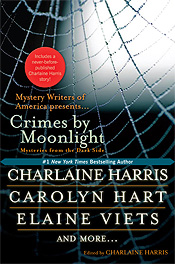
Harley Jane Kozak has contributed to a number of short story anthologies, including Crimes By Moonlight: Mysteries from the Dark Side.  In “Madeeda,” nominated for an Agatha Award, an expectant mother is concerned over her two-year-old twins’ visions of a bad witch.

Here is Harley’s take on inspiration:

My short story ideas occur in little intuitive flashes, like headlines out of National Enquirer — “Bride Flees Wedding When Fiancé Insists on 4-Tined Forks!” or “Twins See Purple Ghost Asleep in Master Bedroom!” or “Drunken Man Mistakes Soccer Mom for Lamborghini!” Most often it’s some small, strange incident from my own life that I file away, knowing I don’t have the time or perspective to write about it just then. But it’ll hang around in the file cabinet of my psyche and one day, when I least expect it, I’ll understand what realm it’s in, literary fiction or crime fiction or horror, or I’ll just feel the need to start writing it, or else someone will ask me to write a story and I’ll think, “Yes, now’s my chance to write about the guy who thought he was Jesus and tried to kill me.” I start to deviate from real life soon after the initial premise, and I never know how the story’s going to end, and once I figure it out, I go back and revise, revise, revise, making the story shorter, shorter, shorter. It takes me forever to make it short enough. That’s one of life’s cruel jokes, how long it takes to write a short story. 

Kaye George’s short works have appeared in print, online, and in anthologies, including her recently recently A PATCHWORK OF STORIES (and FISH TALES!)  In 2009, her short story “Handbaskets, Drawers and a Killer Cold” received an  Agatha nomination.

Like the seasoned short story pro I know Kaye to be, her advice was direct, brief and infinitely helpful:

Short stories are easier for me. I think that’s because I can hold a whole short story plot in my mind at once. Also, my long pieces tend  to turn out too short. All you really need for a short story are a protagonist, a problem, and a solution. Anything else is optional. I prefer a twist at the end, too. Even better, a double twist.

Many thanks for sharing your thoughts. If anyone reading would like to share as well, please do!


To Be An Active Writer, Part 2

~This article originally appeared in the April, 2011 issue of FIRST DRAFT, the newsletter of Sisters in Crimes’ Guppy Chapter. Susan Evans, Editor.~

PART 2—Active Words and Word Choice

Writing actively is not the same as writing action.

Some verbs are dynamic: Scream! Punch! Shove! Jump! Swing! Gurgle!

Others show action that is quiet: Consider. Dream. Pause. Ponder. Whisper.

Whether the action is brazen or calm, the word that describes it should be clear and graphic.

An action word should also be precise. How many words describe the act of looking? Take a moment and write a list. Your list may include words like stare, peer, gaze. Do all of those words mean the same thing? They are all forms of looking, but is staring at someone the same as peering at them?

Again, back to the dog.

Compare the following:

(A) “I stood at my window and watched my neighbor beat my dog.”

(B) “I stood at my window and saw my neighbor beat my dog.”

I changed one word—from watched to saw. How did this one word change make the sentence different?

“I watched my neighbor beat my dog” implies that the subject stood through the completion of the act, in this case the beating of the dog. The beating may have been brief, or it may have gone on all afternoon. There’s not enough information in the word “watched” to determine an amount of time. The implication is that the subject watched the entire beating.

“I saw my neighbor beat my dog” shortens the time. “Saw” has a quicker implication. It means that the act (the beating) made a visual connection with the subject. As soon as the scene was witnessed, it registered as being seen. Thus the subject only had to note one visual timeframe of the beating for the verb to have done its job.

Why do small changes like this matter? Because there are subtle differences between watched and saw; between peered and stared; between gaze, gape, and gawk. A single change of a word can change the nuance of the sentence. It also changes what the sentence may say about the subject. Strong words bring power to your writing.

Why did I include dog abuse in this article?

Our old friend Hamlet might stand at the door and watch the dog get a beating. Do you want your characters to be that passive? Or do you want them to take action?

~Addition:

At a recent conference workshop, I had students think of words to describe the act of walking, specifically someone walking across a yard. Some suggestions were marched, stalked, ambled, rushed, strolled and loped.

We examined the word loped, by considering the following questions:

Can a short person lope? (No.) Can a heavy person lope? (No.) Can an old person lope? (No.) If a person is loping, are they feeling distressed? (No.) Are they in a rush? (No.) 

By using this one word, we pictured a character who was tall, thin and young. We could surmise that nothing terrible had happened to him or around him because he appeared unhurried and calm.

The single word gave us hints about physical traits, emotional state and plot. That is what a powerful word can do.

How To Be—or Not to Be—An Active Writer

~This article originally appeared in the April, 2011 issue of FIRST DRAFT, the newsletter of Sisters in Crimes’ Guppy Chapter. Susan Evans, Editor.~

Poor Hamlet. On paper, he had everything an up and coming young man could want: strong father figure, loving mother, loyal friend, hot girlfriend, good education, royal title.

But as those of us who write crime fiction know, one good murder can derail someone’s bright future. In the backstory, Hamlet was charming, carefree and second in line to the throne, but when we met him in Act I, he was hollow-eyed and hounded by a ghost to get off his duff and get some royal vengeance, already.

Had he made sharp, strong choices to avenge the king, Hamlet would have lived on in literary glory as a proactive prince. Instead, he vacillated and rationalized all over Denmark and beyond. His “to be” soliloquy may be memorable art, but action was not Hamlet’s forte.

So how does Shakespeare’s great tragedy relate to mystery writers? Imagine a writer who has all the vital prerequisites for a corking good mystery: a brave protagonist, an intriguing crime, an interesting setting, a compelling theme, maybe even a clever twist or two.

Now imagine that, like Hamlet, the writer wastes all that promise by making dull, indecisive writing choices.

~ What is active writing?

Writers tell stories through a series of sentences. A writer chooses a sentence structure and specific words to convey an idea or show an action. An author who wants to hold a reader’s interest will learn to write compelling sentences that use language efficiently and add power to those sentences by imbedding them with sharp, descriptive words.

Strong structure combined with dynamic word choices will create active writing.

PART 1—Active vs. Passive: How to construct a strong sentence

A sentence written in the active voice uses the basic subject-verb-object structure. You can also think of active voice as three W’s: who did what to whom.

Example: My neighbor beat my dog.

A passive voice version of this sentence reverses that order to object-verb-subject. The three W’s are also shifted: who had what done to them by whom.

Example: My dog was beaten by my neighbor.

These are simple examples for a purpose. Who did what to whom is easy to repeat and remember. Who had what done to them by whom is an awkward tongue-twister. The two sentences above reflect that. In the first sentence, the author tells who is doing the action in a simple but effective fashion. In the second sentence, the object is the recipient of the action. The neighbor—the subject—is moved to a secondary position. In a strong sentence, the subject always gets top billing.

It also requires fewer words. Seven words as opposed to five may seem trivial, but add two words to every sentence in your manuscript and watch the word count skyrocket. Why say in seven words what you can say in five? Nobody likes a blabber mouth. I mean, look what became of Polonius.

An active sentence is one that shows what happens in the most direct, engaging and efficient way possible.

~ Is passive voice all bad?

Is it ever okay to use the passive voice? Of course! Readers, like writers, enjoy variety. Sentence after sentence of the same structure can get dull.

~ When is passive voice best applied?

When the receiver of the action is more important than the performer of the action. Example: Jimmy Ray was arrested. (Does it matter who arrested him? If not, don’t mention it.)

When the performer of the action is unknown. Example: The jewels were missing from the museum. (Were they stolen by thieves? Misplaced by a careless curator? If you don’t know, you can’t tell.)

When the author deliberately wants to hold back information. Example: The night before the Derby, a million dollar race horse was set loose from its stable. (The writer may not want to identify which race horse, or who set it free, or why. In mysteries, withholding the Who’s and Why’s spark interest in the puzzle.)

~ When, in dialogue, a character wants to shift or mask blame. “Mistakes were made,” said the police chief. (Obviously, those mistakes were made by his officers, but the chief’s not going to throw his guys under the proverbial bus. This phrasing tells us a bit about the chief, too.)

Passive voice is not incorrect. It’s just not active. In the right circumstance, passive voice has a place in a manuscript.

~ What about To Be/linking verbs?

While Hamlet’s famous query may show his wishy-washy nature, “to be” verbs are not inherently passive. The “to be” verbs—am, are, is, was, were, be, been, being + their many forms—do not show action. They show a state of being. A “to be” verb does not show that the Who in the sentence does something. It shows that a What has been done.

Does this make “to be” verbs passive? No. Does it mean “to be” verbs are the best choices for active writing? Again, no.

To illustrate, let’s go back to the dog.

Example 1: I was standing at my window, watching my neighbor beat my dog.

Example 2: I stood at my window and watched my neighbor beat my dog.

Both sentences describe the same scene, but Example 1 tells what the subject is doing; Example 2 shows the subject doing it. As every writer has heard a zillion times, showing is better than telling.

Is there such a big difference? In both sentences, the poor dog is getting it from the neighbor. Both sentences share the same information, but the active sentence is more direct. It does what writers are always told to do: show the act instead of tell what happened.

TOMORROW – Active Words

FREE WRITE – POPPIES

In honor of Memorial Day, the Get Out & Write! Community Free Write devoted two prompts to commemorate the holiday: “in the trenches” and “poppies.”

The poppies prompt was inspired by the poem, “In Flanders Fields,” written in 1915 by Lt. Col. John McCrae, but instructions were to write anything related to poppies.

Below are several of the results of our POPPIES prompt:

“The field next to our house was planted with wheat, and poppies, gorgeous, velvet and red, grew in among the stalks, as well as morning glories, the black throats of the poppies and the white throats of the blue morning trumpets like ventriloquists’ dummies mouthing the liquid songs of invisible skylarks overhead. Before the combine harvester came through, and again after the harvest was cut down, we children would rescue nests of harvest mice to save them from being burnt up in the stubble fires, carrying the squirming little drops of pink in their round purse-pockets to the hedgerows where we thought they might be safe. There were endless jobs to be done at home, but our parents didn’t realize how many impossible jobs we were also trying to do in the wider world, where the wheat fields filled with pockets of mice stretched to the horizon.”Maggie Rowe

“I found the poppy on a grave. It was because the poppy was there, like a bright splash of blood, that I noticed the grave at all. Obscured by grass, the marker, a gray, shapeless lump, had all but dissolved. Other markers near this one, of a similar stone, appeared to be from the same time period. All were weathered, streaked and discolored, but the names of the dead were still visible. Why then was this one stone in an extreme state of decay? And, I wondered, if this grave was the same age as its fellows, who was the nameless soul buried here who still attracted visitors bearing flowers 150 years after his or her death?” – JM Reinbold

   “It’s a derivative of poppies.” His eyes are glazed, the pupils so dilated they seem to be devouring his irises. “It’s natural.”
   “Dog shit is natural, but I wouldn’t want to grind that into a powder and snort it,” Kelly says.
   They sit together, knees brushing. Dave nurses a beer, while she sips a flat Captain and diet.   The bar is crowded; it’s the only one within ten miles of the dry college campus. It’s dim and smoky, and the people are hushed, dismal and attenuated like the cigarette smoke floating in the air. Dull eyes. Everyone’s got such dull eyes.
   “It’s not that easy. You’re so judgmental.” Dave looks down and starts peeling the label off his Stella.
   “I am. You’re right. I miss you, though. I miss my brother. Where did you go?”
   “Oh, Kelly. I think I must have left when Mom did.” He grimaces at her boxy suit and conservative shoes. “Don’t try and pretend that you didn’t leave, too.” – Kristy Truax-Nichols

“Every year my two brothers and I met at Mom’s to plant the annual garden. Never before Mother’s Day and mostly on Memorial Day weekend, we would gather before the break of dawn on the front porch that looked a bit more forlorn each Spring. My brothers, never early risers, would wait for me, coffees in hand,and sleep still clinging to their eyes. I would pull the flats of flowers from the backseat of my Toyota while the two of them watched from the top of the steps.   A tray of Dusty Miller for the border, a few pots of Snap Dragons, Mom’s favorite, and a box of red Poppies to honor Dad.
   Mom never came out until she called us for breakfast about an hour or so after we arrived. My oldest brother, Paul,had begun raking while Billy gave advice as to how he could do it better if the raking were his job.” Kimberly Kurth-Gray

“I heard a marvelous story about “Tall Poppies” that turned a paradigm on its head.  I’ve forgotten what country or culture it is, maybe Australia, but they teach their children not to be “tall poppies” – for it is the tall poppies that get noticed and cut down, presumably for floral arrangements or, maybe, to make all the flowers the same height, a strong message for fitting in.  So the children grow up in fear of being cut down one way or another, and they rarely dare to let their special gifts raise them above the average level.

A far-seeing woman in the States heard this teaching and was very troubled by it.  She knew it is our special gifts that raise us to our highest potential.  Kendall SummerHawk wanted to encourage this in other women.  So she started a program for women called “Tall Poppies”.  She sent out the word, seeking women who dared to believe that with support they might fulfill themselves and become all they could be.

I don’t know the details of this program but from other programs of Kendall’s I’ve been in, I would hazard several guesses.  Most likely they explored their dreams and unfulfilled goals.  Probably the women wrote and talked about what they’d been discouraged from doing or being, things like

“Don’t be so sensitive.

 “Of course, there’s nothing beyond solid, scientific fact.”

 “Curb your exuberance.”     

 “Writers and artists can’t make a living at their craft.”

 “Major in something practical.”

 “Women can’t …….(fill in the blank).”

 “People in our family don’t do that.”

And from what I have heard I imagine that the women listened to their hearts and their spirits.  They became tall poppies, supporting each other and going for their dreams, exploring their talents and taking big risks.  They rose to heights never before attempted – and no one was cut down.”  –           Betty Powell


Working on my Woo-Woo

A couple of weeks ago, someone told me I was scary.

Me? Come on. I’m short. I have curly hair. One of my favorite colors is pink. My office (aka “The Bunker”) is functional, but it’s also prettily decorated–dare I say, even feminine. I’ve hung vintage dessert plates on the wall, for pete’s sake! How could someone like this be threatening?

But then I saw a photo of this person…

who is also short, with curly hair, wears pink and likes vintage china. 

Oh dear.

Whatever you’ve heard, I am not the Dolores Umbridge of editing.

After pondering (aka “flipping out”) about it for a few days, I finally understood that the person meant “scary” in a Stern English Teacher kind of way. It wasn’t me in particular who was frightening, either. It was the idea of working with me, and not me in particular, either, but any editor. It was the concept of having his writing project read, judged and critiqued that gave him the heebies.

Whew. Glad we cleared that up.

I was also encouraged when, at the Pennwriters Conference last week, a person told a group that I was a good editor, but more importantly, I left a writer with her dignity intact.

Another whew.

Nevertheless, I’m glad that the “You’re kind of scary” comment was made. Not unlike characters in the works I read, it’s good for people to change and grow. I’ve been thinking of ways to change and grow as an editor.

Hence, I am working on my woo-woo.

In case you’re not familiar, woo-woo is the term writers (and others) give to all things supernatural, touchy-feely, paranormal, or emotion-based. Ying, yang.  It’s your Zen, man.

This is sort of not me. I’m not New Age, I’m Old French. I jab at voodoo dolls instead of applying a healing touch, and the closest thing I have to a touchstone is a Jane Austen finger puppet.

But hey, grow and change. I like a good paranormal story as well as the next girl, and I’ve got some Dashboard Confessional on my iPod.

There are some editors who are big on telling their clients to go out into a field, sit on a rock and ponder the possibilities of their characters. I don’t do this. I’m more of the sit your butt in your chair and wrestle with character consistency until you get it right. Or, go for a walk and think about it, but bring a notepad, because if you don’t, you’ll have a brilliant epiphany 2.3 miles from your house, and you’ll have to run home, and by then you’ll have forgotten the brilliant epiphany. Been there, done that, friends.

But maybe because it’s been raining all week, the idea of sitting on a rock in a field while pondering the possibilities sounds appealing.

Grow and change, grow and change.

But…how? This is the challenge. Where does a practical person like moi begin on this path to be more woo-woo?

So. Have you found enlightenment beyond the glue-your-butt-to-the-chair method? Something esoteric or emo? How did you grow and change to see possibilities?

Please tell me. If you do, I might let you play with my Jane Austen finger puppet.

Ramona


Get Out & Write! Community Free Write

Saturday, May 28, 10:00 a.m. – Noon

Kirkwood Library Community Room

A free write is an informal gathering of writers who meet to practice their writing. Free writing can help you discover new story ideas, dissolve writer’s block, or move forward on a work in progress. Most importantly, free writing is fun and a great way to fellowship with other writers!

The series is open to anyone interested in writing. Writers of all skill levels are welcome. Bring a notebook, pen/pencil or laptop. There is no charge. No RSVP is required. Just show up with a desire to write.

Post-Pennwriters Depression

This weekend in Pittsburgh, while serving cup #761 of conference coffee, I heard a jingly sound behind me. This sent my finely developed jewelry radar on red alert. Sure enough, when I turned around to check it out, behind me was an arm with four silver bangles on it. Attached to the arm was a Pennwriter.

“Oh, I love your bracelets!” I said and held out my arm to show her mine. When you are a bracelet junkie, this is the proper show-off protocol.

I wear three silver bracelets.  Always. I add others for variety, but these three are my constants. One I bought at the French Quarter when it first opened after Katrina; one is a treasured gift from a special friend; the third is a solace bracelet I treated myself to after bombing a public reading at the Pure Sea Glass Writers Conference in Rehoboth.

(How do you know you’ve bombed a reading? Maybe your gut says you were off your game, but the audience politely applauded, so you tell yourself it couldn’t have been that awful, right? But later, someone approaches you at the bar to say, “I was at your reading and I wanted to tell you, I really like your shoes”–that’s how you know. I fled the bar and ducked into a local artist’s gallery and soothed my wounded pride by buying myself a cute bracelet.)

Back to the Pennwriters Conference. After I gushed over hers and showed off mine, the woman started to remove one of her bangles. I watched in shock as she pulled it over her wrist and fingers and then handed it to me. Of course I protested (albeit weakly), but thirty seconds after I admired this stranger’s bracelets, she had given one to me.

That, friends, is what happens in a community of artists. For four days, the 200+ writers gathered in Pittsburgh gave to one another. Some gave advice on Facebook and LinkedIn; some lent a practice ear to pitches; some served M&Ms; some gave hugs or thumbs up as needed. The best part was, no one had to ask. The offerings were instinctive and sincere. This is what we do.

At my Mastering the Art of Self-Editing workshop on Thursday, I handed out plastic bracelets to the attendees and said they were editing bracelets. I explained that a writer works with a creative mind, but an editor must work with a critical eye. The bracelets were a mental aid, to remind them to shift gears from the creative to the critical.

I wear my three bracelets to remind me of important moments in my life. Now I have a fourth. How often in life do you admire something, and it is given to you, immediately, without expectation of anything given in return?

It was a small but beautiful moment that I will always remember. I am grateful to the lovely lady who handed me the bracelet off her arm in a gesture of camaraderie, but she was not the only person generous to me at Pennwriters.

I am grateful to the person who broke the awkward silence at the end of one of my sessions by asking a pity question.

I am grateful to the woman who brought up Rebecca as an example at my story arc workshop.

I am grateful to the writers who trusted me to read their openings.

I am grateful to the brave individuals who participated in the read and critique session.

I am grateful to every person who offered a personal origin story about how they became writers.

I am grateful to everyone who attended my workshops, chatted with me in the Hospitality Room and offered their experiences and friendship.

I am grateful to the Pittsburgh Chapter of Sisters in Crime for the Saturday dinner invite.

And I am grateful to Julie and Meredith for putting together a flawless conference.

I was sad to leave my friends–both old and new–in Pittsburgh, hence the title of this post. I came home with much more than I gave, and I am grateful for that, too.

*sniffle*

Ramona

PS – They were really cute shoes. 

DLC Workshop Announcement

SUBURBAN  NOIR: WRITING FROM THE DARK SIDE OF LIFE

A Workshop on the Craft of Writing Noir Fiction sponsored by The Delaware Literary Connection and presented by MARY PAUER, MFA

 Saturday, May 14, 2011, 10:00 a.m. – 2:30 p.m., Dover Sheraton Hotel

How do they do it, those skilled writers who build characters that fall victim to their own fatal flaws, who come face to face with the dark side of life in the middle of the night and run screaming from their beds?  Join the DLC and Mary Pauer, MFA, for a workshop delving into emotional noir.  Utilizing short stories from noir author Joyce Carol Oates, we will explore the nuances of writing noir and try our hand at in-class exercises.  Participants will be assigned several Oates’ stories to read prior to the workshop (materials provided by the DLC), and these will kick off our exploration of this popular genre.

The workshop will be held at the Dover Sheraton Hotel, 1570 North DuPont Highway, Dover DE  19901, just a few blocks from a convenient Route 1 exit.  Registration opens at 9:45 a.m. Cost:  $30/person, which includes lunch at the popular Sheraton buffet.   The workshop is limited to 10 participants.  Please contact graybeg@comcast.net  to register.  Registration is open until 7:00 p.m. on Wednesday, May 11, 2011.

Literary Reading at NCCo Library

Five members of the Written Remains Writers Guild have been invited to participate in a literary reading at the New Castle County Library in Old New Castle, Delaware.

The reading will be Saturday, April 16, in the library’s community room. The event will begin at 2:00 p.m. and a “meet the authors” reception will follow.

I will have the pleasure of acting as emcee for this event. Please join us!


Fish Tales

UPDATE: Trade-size paperback is available at these and other fine booksellers:

Mystery Lovers Bookshop; Barnes & Noble; Amazon

Fish Tales, an anthology of 22 short crime stories by the Sisters in Crime Guppy Chapter, is now available as an ebook! The print version will be out soon.

I was honored to edit this collection for the talented new crop of mystery writers.

Fish Tales may be purchased in ebook format through Amazon; Barnes and Noble; Lybrary.com; Mobipocket.