Needless to Say, or Write

If something is needless to say, why do we say it?

“Needless to say” acts as a disclaimer. It means that whatever the speaker (or writer) plans to say next, doesn’t need to be said. The speaker understands and acknowledges this through the use of the disclaimer–but says it anyway. Why we persist in saying something that doesn’t need to be said doesn’t make much sense, but the phrase is a common one.  Proof? I just used it in the title. Needless to say, I thought it was catchy.

A disclaimer phrase acts as a lead-in–or, perhaps, a warning. Consider the phrase “No offense, but….” Anyone who has ever said, or heard, or been in the vicinity of anyone who has ever said or heard, “No offense, but…” knows what’s coming next. Something offensive.

“No offense, but…” is a lead-in that gives the soon-to-be-offended party time to prepare.  Unfortunately, it’s probably not enough time to run away and not have to hear whatever ignorant, unflattering or insulting comment the speaker feels compelled to make, which just by saying “No offense, but…” shows the speaker knows s/he should not be saying it. “No offense, but…” is a somewhat more polite way of saying, “Brace yourself, I’m about to insult you.”

As I edit manuscripts, I find quite a few disclaimers and lead-ins. I also find words that are needless to write. Sometimes it’s repetition or redundancy.

Example: “She gave a final, last push against the door.”

Final and last? This reminds me of when I tried to train my dog to sit. I was an inexperienced dog owner. I didn’t know about first you say, then you show. I would give the command–“Sit!”–and my dog would continue to stand. Usually,  she’d wag her tail, to show she was happy I was talking to her. Instead of reaching out and pushing her bottom to the pavement to demonstrate “Sit!” I would repeat the command. Over and over. I’m sure, at least once, I said, “This is the final,  last time I tell you to sit!”

My dog never learned to sit properly.

Here’s another example: “He popped off a quick fast jab.”

This may be for style or effect, but it’s still overkill.  The use of words that mean the same thing, twice, don’t add information. They just add to the word count.  As a reader, I am reading more words, without learning any more information.

This one reminds me of word problems in math: “John was taking the train to Baltimore, so if the train traveled at the normal speed for 10 miles and a quick fast speed for 15 miles, what time would John arrive at the aquarium?”

I was never any good at word problems.  

Oftentimes, needlessly offensive words hang around our body parts.  

Example: “I nodded my head.”

Your head? Really? As opposed to nodding your foot?  Your elbow? Your spleen?

Example: “I shrugged my shoulders.”

Shoulders are the #1 recipient of shrugs. #2 would be…there is no #2 in shrugging. You shrug your shoulders because no other body part can be shrugged.  You can “shrug it off” but the “it” is relative, and no matter what “it” is, if you shrug it, your shoulders are involved. You can shrug off your jacket, but again, there are the shoulders. Face it. Shrugging = shoulders. Which means, you don’t have to write it down. It’s understood.

Example: “I waved my hand goodbye.”

“Wave” is a fine example of a verb that can be applied to a plethora of choices. You can wave a flag. You can wave a handkerchief. You can wave your hair. Wave is a busy little verb. But if you write, “I waved my hand goodbye,” you’re wasting words. “I waved goodbye” is good enough. We know your hand was involved.

It’s akin to writing, “My legs ran across the road.” Think how busy your legs would be if you included them in every sentence. “I bent my legs at the knees and sat.” “I propelled my legs forward in a speedy motion and ran.” “I used my legs muscles to raise myself and stood up.” Do we write this way? No. We write, “I sat.” “I ran.” “I stood up.” 

This reminds me of one of my favorite sayings about writing: Characters sleep and go to the bathroom, but that doesn’t mean I want to read about it.

And no offense, but…if you are including all that stuff about the legs, you need to work on your writing. 

Does this apply to every body part and verb? No. “Cross” can apply to a range of body parts. You can cross your arms, your legs, your eyes, your ankles. (You can also cross your enemy to show danger, cross off a tip, or cross yourself to show faith, but that’s another blog.) So if you write “I crossed” you need to add a body part.

Ditto on licked: “I looked into his handsome face and licked my lips.”

Now leave out the body part. “I looked into his handsome face and licked.”

That might be fun, but it sure changes the meaning, doesn’t it?

Language can be general, or it can be specific. Meaning can be interpreted. Word count, however, is a number. If you don’t need extra words, don’t add them. If you do, you’ll make the reader work unnecessarily hard, and that might make them late to catch the train to the aquarium.

And needless to say, this is the final last time I will write about it.

As Inspired By….

If May Sarton were alive today, I bet she’d have a blog.

May Sarton—poet, novelist, journal keeper extraordinaire—published numerous works over her long career. I’ve read many of her novels  and enjoyed her volumes of poetry, but May’s lasting legacy to the writing world lies in the dozen journals she published.

In those journals, May Sarton addressed both the craft of writing and the challenges of a writer’s life. She wrote about a writer’s need for solitude. She wrote about her garden, her cat, her house by the sea. She confessed her worries about growing older, her heartbreak when her long-time partner began to suffer from dementia, her own recovery from a stroke. When a book review was disappointing, she wrote of its sharp bite. She shared stories of the students who visited her and the obligation she felt to answer when a letter came asking for advice. She expressed frustration when her writing life took up more of her time than her writing, but also joy in realizing that those demands came from people who appreciated her art.

Writers are often inspired by the memoirs or advice of other writers. I am grateful that May Sarton graciously shared so much of herself. Despite many reads, each time I open and read her observations, I always find some new insight.

Thank you, May Sarton. If you were indeed alive and blogging, I would follow you.

I have long wanted to express the above sentiments. A few weeks ago, after a comment on  How Many Pages Did You Write Today? about the impact a particular writing book had on the writer, I decided to do my May Sarton blog. To honor her  generosity, I’ve invited some writing friends to share their thoughts on books that inspired them.  

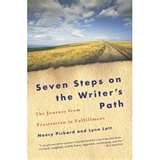
~ ~from JULIE LONG, on Seven Steps on the Writer’s Path by Nancy Pickard and Lynn Lott:

I’ve read some great books on the craft of writing, but the book that has impacted me the most is one on the psychology of writing. Seven Steps on the Writer’s Path: The Journey from Frustration to Fulfillment by Nancy Pickard and Lynn Lott. It came to me at a time when I didn’t think I was on a writing path at all, when I thought life and self-sabotage had detoured me horribly off-course (again). The book revealed that I was actually on one of the seven steps and showed me how I could continue the journey.

(Julie blogs more about it here…http://julielongwrites.com/2011/02/a-funny-thing-happened-on-the-way-to-those-revisions/)

~ ~ from BARBARA ROSS, on Stephen King’s On Writing.

When Ramona asked me to write about why I love Stephen King’s On Writing, I found I had trouble articulating it. So I pulled the book off the shelf–and was immediately sucked back into it. I could have re-read the whole thing. That’s how compelling it is. The book is divided into three sections; the story of how King was formed as a writer, guidance on how to write, and a final portion, written as he recovered from his catastrophic injuries after being hit on a country road by a van, called “On Life.”

On Writing is highly entertaining, but King takes himself, his craft and the reader seriously. We all need to imagine a writing life, and he helped me immensely in imagining mine.

(Barb shares a Maine connection with Stephen King. She can be found hanging out at the Maine Crime Writers blog.)
~ ~ from GENIE PARRISH, on “Write Like Hemingway” by R. Andrew Wilson, PhD

Despite the title, this is not actually a book on how to write exactly like Hemingway, but rather on how to learn from him and write better. A quote from Papa might be: “Keep them people, people, people, and don’t let them get to be symbols.” To this, Wilson adds: “Should the writer find a character too perfectly fitting into some artistic ideal, he should remember all the contradictions of human personality.” He gives exercises, as most “how to write” books do, but then adds “What’s the Point?” in which he explains exactly why the exercise can help you develop your skills. As Wilson says in his introduction, “Let us see what Papa has to teach us.” He leaves it to the reader/writer to decide what she wishes to learn.

(Genie is participating in her own adventure this summer, traveling across the South to hear veterans’ stories: http://www.swrnn.com/2011/07/31/lake-elsinore-four-women-journey-across-america-to-hear-veterans-stories/)

~ ~ from HOLLY GAULT, on Anne Lamott’s Operating Instructions:

Most writers choose Lamott’s Bird by Bird as her influential writing book and it is wonderful. I probably remember most her constantly running inner radio station, KFKD, and how she has to pull the plug on the radio. To me, Operating Instructions is where Lamott put all her self to work, heart and soul. She writes of recovery from drugs and alcohol, the birth and early years of her son, and the wrenching death of her best friend.

Anne Lamott writes honesty. She slices open her chest so we can see what makes her heart beat. She turns on those bright lights of the OR so we see every crevice and wrinkle, the weirdities and absurdities of her life. She then sews it all up and we can all breathe easier.

(Find out more about the multi-talented Holly at HOLLYGRAPHIC ARTS.com)

~ ~ from KATHY WALLER, on Julia Cameron’s The Artist’s Way

A dozen years ago, experiencing burnout on both personal and professional fronts, I consulted a therapist. He said, “Write.” But with two degrees in English, I had no idea how to begin, and several dozen books about writing didn’t show me. Then I happened upon Julia Cameron’s The Artist’s Way, and stepped into a new world. Instead of learning how to write, I would open myself to my own creativity. I embarked on Cameron’s twelve-week program, did morning pages, artist dates, became reacquainted with myself, my dreams, my strength, my faith. In the process, I changed. I became a writer.

(Kathy blogs at the aptly named to write is to write is to write.)

Have you been inspired by a writing book, a memoir, a journal? Tell us about it.

Ramona

Get Out & Write! Free Write

Get Out & Write! Community Free Write

Saturday, July 30, 10:00 a.m. – Noon

Kirkwood Library Community Room


A free write is an informal gathering of writers who meet to practice their writing. Free writing can help you discover new story ideas, dissolve writer’s block, or move forward on a work in progress. Most importantly, free writing is fun and a great way to fellowship with other writers!

The series is open to anyone interested in writing. Writers of all skill levels are welcome. Bring a notebook, pen/pencil or laptop. There is no charge. No RSVP is required. Just show up with a desire to write.


Is Your Story on Cruise Control?

On the day I packed my first car with stuff for my first apartment, my dad gave me some useful advice. “Don’t lock your keys in the car.”

Does anyone actually need to be told that?

Apparently I did, because after I put the keys in the ignition, I decided I should “freshen up” one last time. (A leftover from summer car vacations and Daddy’s pre-boarding announcement: “Do your business now because I’m not stopping until we hit Mobile!”) I got out, closed the door—which was locked. One set of keys back then, too, so we had to call the dealer to cut a new set.

After that day, every time I left home, Daddy’s parting words were, “Don’t lock your keys in the car.” This spring, I noted in “I’m A Big Girl Now” how I finally redeemed myself, but I never locked my keys up again. I learned my lesson.

I’m not a car person. Like a lot of writers, I do like long drives that allow me to think about a story problem, but vehicle prestige means nothing to me. I care about gas mileage and dependability.  My husband bought a new car a few weeks ago. I’ve never driven it. It’s blue. That’s all I know.

Oops, I lie. I also know there’s no cruise control, because he complains about it.  I never use cruise control. It makes me feel out of control. I may not care about a car’s make or model, but I do want to feel in control when I’m driving it.

In writing, control is important. Every story, every tale, is about control. Think about it. Control. Who has it, who wants it, who needs it, who steals it, who denies it. What is being controlled. Why is it being controlled. What happens if the wrong person gets control. What happens when the person or entity in control gets out of control. What happens to the person who loses control.

To continue the car theme, a writer is the driver of the story. It’s the writer’s job to set the pace, move it along, and navigate the trip. It’s a big challenge, and unlike real drivers, there are no set rules and laws about a writer’s journey.  No cruise control that allows the story to write itself.

Ergo, it’s easy to lose control. How? Here are a few ways:

DROWNING: What happens if your car won’t start and you give it more and more gas as you wait for that magical sound of the engine turning over? You drown the engine and make it worse.

In writing, drowning is overloading the reader with wave after wave of information that is not action. It can be the dreaded back story info dump. It can be a long, misplaced description. It can be the history of a place, or a person, or a relationship. Whatever it is in particular, if it stops the story so that the reader has to stop to digest it. It halts momentum and destroys suspense. It kills the engine. You can’t control a dead engine. You, as a writer, will have to work much harder to bring the story back to life—if the reader hasn’t walked away to find a more dependable vehicle.

MEANDERING: Who doesn’t like a Sunday afternoon drive through picturesque scenery? What writer hasn’t written a character who pops up and does something unexpected?  A “Where did that come from?” moment can be intriguing, and it might lead your story down an unexpected path—or it might derail the whole thing. When a plot starts to go off on tangents or spends too much time on a secondary storyline, or the author intrudes to babble about a political message, social commentary or pet peeve, the reader is taken out of the real story.

If a great new unplanned idea pours out through your fingers, take a moment to consider where this is going. How will going there affect the primary plot line? Joy rides may be fun, but they can also end in disaster.  Not everyone outlines or uses note cards when creating their stories. I’m not going to try to pen in a person’s creative process. But maps can be your friend and get you to the end of the story journey in the most sensible and economical way possible. It can be a written map or a mental one, as long as you know the final destination, and how to take a reader there without needless wanderings.

STALLING – Stalling is not the same as drowning. Stalling is what a writer does when a difficult scene is ahead, and the writer doesn’t want to write it. It may be an action scene, which many writers find hard to control because of numerous characters or complex staging. Characters must be unnaturally aggressive, or there may be violence or danger. It may be a highly emotional scene, with intense internal conflict that’s tough for the author to address.

How do writers stall? They give their characters mindless tasks to do before they head out to the climactic scene. They write long dialogue exchanges that reek of avoidance. They over describe every move the character makes, or over explain why the character makes every move he makes.

If a tough scene is ahead, and you find yourself writing and writing but never getting there, take a look at what you’re writing. Is it moving you closer to the conflict, or stalling you in one spot to dither? Don’t dither. Shift. Press the accelerator. Move forward.

SPEEDING – You’re almost at the end. It’s so close, it’s palpable. You feel that “almost there” rush.  And thank goodness, because you’ve been working on this for a year and it’s time to finish and be done! So you type like a fiend, and then voila! C’est tout! And so what if maybe you didn’t explain very thoroughly or show the character’s emotional responses or tie up every loose end. Readers like to reach the end without a lot of malarkey dropped around. They aren’t dumb. They don’t need every little thing explained to them, do they?

Readers don’t want to feel rushed, so an adrenaline kick for a writer may translate into a rush job for a reader. Readers aren’t dumb, and they don’t need to have story points rehashed after a climactic scene, but a denouement is important. You and the reader have been together for 300-400 pages. She’s grown fond of characters, or grew to hate them. Either way, an emotional tie has been made. Speeding through the payoff is going to frustrate a caring reader, and leave them unsatisfied. Slow down, speed demon, and enjoy the last leg of the journey. Leave your audience something to think about. Everybody likes a trip souvenir.

Do you have trouble maintaining control of your story? Some hints on how to keep pace? Tell me about it!

Guest Blogging at the Working Stiffs

Today I am guest blogging at the Working Stiffs.

My post, “A Position of Trust,” is about Dr. Earl Bradley, a pediatrician whose crimes in a small town in southern Delaware rocked the entire state. Bradley has been described as the worst pedophile in American history–but have you even heard of him?

More importantly, why didn’t anyone stop him?


Seven Questions about Writers Groups

Yesterday at the Chestnut Hill Book Festival in Philadelphia, I presented a workshop on Starting a Writers Workshop. Below are some of the questions asked by the group to me, or by me to the group, on the topic of writers groups.

What are you looking for in a writers group?

This is ground zero for a writer seeking the group experience.  Some self-examination is crucial before you begin the search for an existing group or dive into forming one of your own. Are you looking for feedback on your work? Are you searching for like-minded people to discuss the writing life? Do you want some help in sparking your creative processes? Do you want a spiritual rather than hands-on experience?

You can’t address your wants and needs if you do not define them, first to yourself and then to others. Ergo, the first thing to do is to complete this sentence, “As a writer, I am seeking a group that will ___________________.”

What are different types of writers groups?

These are my own names and definitions, but here’s an idea of various group types:

CRITIQUE GROUP: writers meet to exchange and evaluate one another’s work.

WRITERS GROUP: a support or inspirational group that meets to discuss aspects of writing: the craft, the state of the business, the state of your writing, opportunities for publishing.

WRITING GROUP: meets to write. Members can do specific writing activities using free write prompts, exercises, themes and so on, or members can meet and do quiet writing on their own projects.  

WRITERS WORKSHOP: members meet for classes or courses, taught by other members or by guest speakers, on craft, promotion, publishing, etc.

How long are you committed to a group?

As with the above, there are different answers to this question. Groups can meet indefinitely, or for a specified time. This most often applies to critique groups. Some options:

LONG TERM:  This group meets for as long as the writers want to participate, with no set ending date or goal. I like to call this an Infinity Group.

PROJECT SPECIFIC: This group meets for a specified amount of time, to help writers critique a particular work. For instance, four writers with completed manuscripts may meet once a month for a year, to critique one another’s manuscripts. At the end of the year, the group may disband, or start all over again with a new project and timeline.

BOOT CAMP: This is a project specific group on speed. Small group of writers meets over a few weeks or a couple months (often in summer) for an intense review/critique period.  

How do you find existing groups?

Seek and you shall find. Try the library, professional workshops, writing courses, bookstores, universities, arts organizations, professional genre organizations, online groups, word of mouth. Go where writers hang out and ask around.

Joining an existing group has pros and cons. Pros are that the rules are set and you join and follow them. Like anything else, joining a group as a newbie can be a challenge.

How do I start my own group?

First, ask yourself the question above: What do you want from a writers group? After you’ve answered that, start hunting for fellow writers. Before the first official meeting, have a planning meeting to decide the details: How often will you meet?  Where will you meet? Do you want peer level members (meaning, everyone is published, or everyone is new) or is a mix okay? How many members? If you submit, how many pages, how often, how will the pages be distributed? Will there be a leader?

What destroys a writers group?

The devil is in the details, as they say. Good groups are destroyed by not having a set meeting time and place; by not having regular attendees; by not having a time monitor so a group may spend 45 minutes on one story and 10 on another; by an overbearing or a difficult member; by members who want different things from the group; by members who won’t, or can’t, critique work in different genres; by having too many members. This is why being upfront with your expectations is important. If a new group has a planning meeting and everyone is in sync about what they want and how meetings will be run, and the members respect that, you can have a successful, helpful group.

What about online options?

Many writers participate in online support groups, and/or manuscript exchanges with writers they’ve never met in person. Lots of professional organizations (Sisters in Crime, SCBWI, Pennwriters, Romance Writers of America) have list serves for discussion and critique programs for their members. Do some research in your genre.

If you are looking for a writers group, there are many out there. Be assertive. Understand what you want and seek out like minds. Good luck!

Chestnut Hill Book Festival

On Sunday, July 10, I will participate in the Chestnut Hill Book Festival.

I am pinch hitting to present “Starting A Writing Workshop.” If you are interested in starting or seeking out a group of peers to review and discuss your writing, please stop by for some pointers.

“Starting a Writing Workshop” ~ Sunday, July 10th, 2 p.m. to 3 p.m.

Bombay Room of the Chestnut Hill Hotel, 8229 Germantown Avenue, Philadelphia, PA 19118

2011 Delaware Regional Writers Conference

2011 DELAWARE REGIONAL WRITERS CONFERENCE

Sponsored by The Delaware Literary Connection and the Delaware Division of the Arts

Saturday, September 24, 2011, Wesley College, Dover, Delaware

Presenting Artists/Workshop Leaders

POETRY

JoAnn Balingit – Delaware Poet Laureate; Educator; One City One Prompt Facilitator

Holly Bass – Poet; Writer; Performer; Director

Regie Cabico – Poet; Spoken Word Pioneer; National Prize-Winning Slam Poet; Playwright

Kim Roberts – Poet; Editor; Teacher

PROSE

Elise Juska – Novelist and Short Story Writer; Teacher; Editor

Faye Moskowitz – Memoirist; Novelist; Creative Writing Program Director

Mary Pauer, MFA – Short Story Writer; DDoA Fellowship Winner

Kathleen Wheaton – Feature Writer; Short Story Writer; MAAF Fellowship Winner

MORE INFORMATION AVAILABLE SOON

Dew on the Kudzu

This week, my semi-memoir, semi-fiction piece called “Dead Horse, Live Daddy” was published in Dew On The Kudzu, an online magazine that celebrates the Southern Written Word.

Most of my written words are Southern in origin. This story is one of them.


Guest Blogging at the Working Stiffs

I like old things. I don’t need to pretty it up and call it classic or vintage. Old is fine.

I also like odd names, which is good when you have a family like mine.

Tablecloths, cake platters and funny family names. This is the discussion today at the Working Stiffs. My post is called “In With The Old.” I’ve also share my sooper-sekrit metal cake cover trick.