The Author Known as Anonymous

That wily writer known as Anonymous is at it again. In just a few weeks, his new book, O: A Presidential Novel, will hit bookstores. No one knows who has written this new story of O, but the guessing is becoming fierce. In fact, if the author is not unmasked by the publication date, I, personally, will lose ten bucks.

O: A Presidential Novel is a roman a clef, which means readers will have the fun of recognizing “characters” and “scenes” in the story as real people and real events. For those not familiar with literary terms, roman a clef is French for “you can’t sue the author for this unflattering portrayal because you are a public figure.”

It’s about time that Anonymous has come out with a new book. His last big seller (not counting the AA Bible, which is Anonymous’ greatest work, in my opinion, and a perennial good seller) was Primary Colors in 1996. Primary Colors is also a roman a clef and it skewers the Clinton administration in a devastating, though amusing and affectionate, fashion.

Primary Colors’ author was outed. He acknowledged his authorship soon after the book came out. I won’t reveal his name here because I want to honor the spirit of anonymity, and because everybody already knows it’s Joel Klein.

The two above novels were marketed as fiction– roman a clefs, political commentary, social criticism, too, but still fiction. Fiction with a message is still fiction.

Which brings me to one of Anonymous’ other greatest hits.
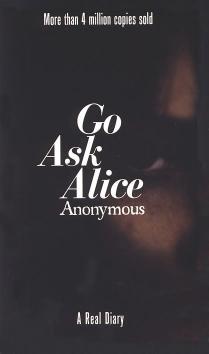
I was in the sixth grade when Go Ask Alice was published. Needless to say, I didn’t buy a copy hot off the bookstore stands, as it was not appropriate reading for a 12-year-old (then) and I was attending a Catholic school that featured a nun who confiscated my copy of Love Story because it was racy and inappropriate. Yes. Love Story.

I read Go Ask Alice a few years later, when I was at a public high school and was blessed with an English teacher who wasn’t scared of controversial books. For those unfamiliar, the book was marketed as the true diary of an anonymous teenage girl who fell into a life of drug addiction. The title is a reference to the Jefferson Airplane song “White Rabbit.” In the book, the narrator never gives her name. Her drug experiences begin at a party, when her drink is spiked with LSD.

From the reading perspective of a 14-15 year old in a small town with no personal contact with anyone who used illegal drugs (as far as I knew), my take on the story was as follows. One minute this girl is sipping a spiked drink, and the next thing you know she’s giving daily BJs to a pimp named Big Ass. (Hey, it’s in the book.) For an impressionable girl, the line “Another day, another blow job” was much more effective phrasing than Just Say No, but you can’t put that on a billboard. Although, at this point in the war on drugs, maybe we should.

My point is, for me, Go Ask Alice worked. I was sure this girl was real; I was nowhere near her world, and I was glad for that, because her world scared the living bejeezus out of me.

So imagine my sense of betrayal when I learned that it was a hoax.

The reveal came several years ago, after I overheard the following conversation in a bookstore.

Customer: I need to know the author of Go Ask Alice.

Employee: The author is Anonymous. We have a copies over here—

Customer: I have a copy. I need to know the author’s real name.

Employee: Ma’am, it’s Anonymous.

Customer: Fine. I’ll look it up on the Internet.

Silly woman, I thought, the author is Anonymous. You can’t find it on the Internet. But of course, I went home and immediately looked it up on the Internet and found out the author’s name. Go Ask Alice was not the real diary of a real girl who drank one spiked drink and fell into a life of fear, degradation, sadness, pain and abuse. It was a “based on” a real person and a “compilation” of incidents.

I was crushed. I admit it. I re-read the book and felt more crushed. As an adult, I saw the manipulation. As a writer, I recognized that the voice was not true to a teenager. As an editor, I noted the glaring bits of author intrusion.

But back when I read it, initially, all I saw was a real girl whose life scared me, made me worry and made me cry.  I believed that diary. I felt every word of it. I felt tricked. Duped. I don’t like feeling duped. Years have passed since I learned that Go Ask Alice is a work of fiction, but I still feel duped.

When writing for a young audience, authors are advised not to write down to them. Be honest and respectful of the reader while acknowledging the level of reading skill. I’ve written for children and understand this challenge, but I would also add to that writing advice to play fair with the reader. Especially a young reader.

Unlike Joel Klein and the soon-to-be-outed-author-of-O, the Anonymous who wrote Go Ask Alice was purposefully deceptive. Which burns my grits.

And yet.

I can’t say that Go Ask Alice is the sole reason that I, to this day, have never even indulged in a puff of mj, but it contributed. Would I have connected to the character as strongly if I knew she was fictional? No. My heartfelt response to her was because I believed she was real. So I wonder. For Go Ask Alice, did Anonymous’ ends justify the means?

Tell me what you think.

Ramona

The Chicken, The Egg and Wet Mr. Darcy

Not long ago, I witnessed a debate on a professional list-serve about creativity. The conversation questioned if artistic, creative people are born that way, or if art and creativity can be taught.

It was interesting to read people’s thoughts on this topic. But then it began to turn into one of those conversations that go round and round in chicken-or-the-egg fashion, like nature vs. nurture in genetics; should prisoners be punished or rehabilitated; does spanking create bullies; and is Colin Firth the one true Fitzwilliam Darcy?

After a while, I checked out of the conversation because my own opinion is, in practical terms of life and work, Who cares?

If I want to improve my skill set as an editor, writer, or any other creative endeavor, I’m going to do so by practice, education, and trial and error. That’s what works for me. In my mind, and world, it makes no difference if my working skills came as a gift I learned to use, or a skill I learned to develop. I just want them, as many as possible, and I want to use them in the best and most efficient way possible. That means learning. Sometimes that means school.

In 2009, when I received an Artist Fellowship from the Delaware Division of the Arts, I used part of the grant funds to attend a week-long short story course at Rosemont College, in Bryn Mawr, Pa. The Rosemont Writers Retreat is presented by Philadelphia Stories and taught by Elise Juska. Spending a week immersed in short stories, with a small group of writers, was right up there with a week at Pemberley, in my book.

This year, I’ve decided to start 2011 with more school, so I enrolled myself in Alexandra Sokoloff’s Screenwriting Tricks for Authors online workshop. The course began on New Year’s Day with a bang of students describing projects and working on premises. Three days in, I have a notebook going full of insightful questions about my own WIP, and a list of books and films to study as structure models. Already I feel I’ve more than earned back the (shockingly small) fee I paid, and there’s still two more weeks to go.

But I confess that while this course is great, story structure is not wholly new territory for me. If I really want to expand my skill set, I need to try a new area of creative work, and push my comfort zone as an artist. This is scary stuff. It’s putting yourself out there. Sort of like what this guy had to do.

You can’t learn if you don’t try, so I’m going to do it. After Alex’s course on story structure, I’m plunging right into…..a poetry class.

Yes. Poetry.

I am not a poet. I like poetry. I read it. I have friends who are poets. They are just like me, except they know how to write poetry. Were they born with that skill, or did they learn it?

I don’t know. I do know that I’d like to know how to write poetry, so I’m taking a course, sponsored by the Delaware Literary Connection and taught by Maryland poet Josiah Bancroft.

Will I write decent poetry? Is there a little poet person living inside of me since birth, just waiting to get out? Is there a black hole where my inner poet should reside and I’ll take this course and find that out? I don’t know the answer. But I know I’ll never know if I don’t try to find out.

Are you starting a brave new decade with trying to learn a new skill? Taking a course? Writing a poem? If so, I’d like to hear about it, so I can applaud your efforts.

I’m not sure it really matters how you learn to create, as long as you answer whatever part of yourself urges you to do it.

It’s sort of like this question: Is there such a thing as too many wet Mr. Darcys?


Tell me about it.

Ramona

Literary Losses, 2010

Every time I watch the Academy Awards, I pull my chair closer to the television when it is time to salute the passing of artists who died during the last year. As 2010 comes to an end, I’d like to do the same and honor the writers who passed away in the last twelve months.

We lost people who helped to create icons such as Pokémon; Holden, Fanny & Zooey; Oliver Barrett IV and Jenny Cavelleri; Jim Rockford and Spenser; The Fiddler on the Roof; and Soho Press.

The first two names on the list are particularly poignant for me.  I fell in love with Louis Auchincloss’s masterfully written portraits of New York and New England society, while Beryl Bainbridge’s harrowing The Birthday Boys gave me a lifelong, albeit long-distance, interest in Antarctic explorers. The world of children’s literature suffered the loss of magically imaginative Eva Ibbotson; it was sad to see Newbery winner Sid Fleischman pass away at 92, but sadder that Poppy Cat’s creator Lara Jones died at 34.

This is certainly an incomplete list, but the following are authors who passed away in 2010, and their most recognizable works

Louis Auchincloss – The Rector of Justin

Dame Beryl Bainbridge – An Awfully Big Adventure

Vance Bourjaily – Brill Among the Ruins

Stephen J. Cannell – The Rockford Files (television)

Philip Carlo – The Night Stalker

Ruth Chew – The Enchanted Book

Lucille Clifton – poet laureate of Maryland

Paul Conrad – LA Times political cartoonist

Robert Dana – poet laureate of Iowa

Sid Fleischman – The Whipping Boy

Dick Francis – The Sport of Queens

Anne Froelick – blacklisted screenwriter

Barry Hannah – Geronimo Rex

Arthur Herzog – Orca, The Swarm

Laura Chapman Hruska – co-founder of Soho Press

James Hudson – science fiction short stories

Eva Ibbotson – The Secret of Platform 13

Elizabeth Jenkins – biographer (Jane Austen)

Lara Jones – Poppy Cat

Robert Katz – The Cassandra Crossing

David Markson – The Last Novel

William Mayne – A Grass Rope

David Mills – NYPD Blue (television)

Edwin Newman – Strictly Speaking: Will America Be The Death of English?

Robert B. Parker – Spenser detective novels

Harvey Pekar – American Splendor

Belva Plain – Evergreen

Elizabeth Post- Emily Post’s Complete Book of  Wedding Etiquette

Hugh Prather – Notes to Myself

Paul Quarrington – Whale Music

Jennifer Rardin – Jaz Parks series

Jeanne Robinson – The Stardance Saga

J. D. Salinger – The Catcher in the Rye

Daniel Schorr – CBS News, NPR Radio

Erich Segal – Love Story

Robert Serling – The President’s Plane is Missing

Takeshi Shudo – Pokemon

Joseph Stein – Fiddler on the Roof

Edwin Charles Tubb – The Dumarest Saga

Ann Wood Waldron – Princeton Murder mysteries

Howard Zinn – A People’s History of the United States

If I left someone out that you would like to mention, please do. The work of these artists will never die, as long as their stories are enjoyed and read.

Best wishes for a good 2011.

Ramona


Guest Blogging at Jungle Red

Today, I am  “Blaming Roger Ebert” with the Jungle Red Writers.

A Feast of Bi…er, Riches

In keeping with last week’s theme of brouhahas, I’d like to resurrect one that is a few months old, between two opponents who seem unlikely to rumble.

I’m talking, of course, about Martha Stewart versus Rachael Ray.

In an interview with Nightline, Martha said Rachael’s cooking and cookbooks were “not good enough for me.” Martha said that she strived to create books that were important, that she was a teacher and Rachael was more of an entertainer.

She also called Rachael “bubbly.”

Rachael Ray may be bubbly, and entertaining, but with this incident, she proved she is no dummy. She acknowledged that Martha’s skills were far beyond hers and, given the choice, she’d rather eat at Martha’s house than at her own.

Martha reacted to the  high-roadedness of this by apologizing. Then Rachael was invited on  Martha’s show, and Martha reciprocated by appearing on Rachael’s show, and what could have been the beginning of a beautiful feud burst like a big balloon of politeness. Not sincerity, necessarily, but ultimately, Martha and Rachael baked a pie together and settled their differences like ladies.

Feuds can be interesting. In the literary world, there was Hemingway’s rivalry with Fitzgerald. Henry James was envious of the popular success of his friend, Edith Wharton, as was Evelyn Waugh of Nancy Mitford, as was Wilkie Collins of Charles Dickens. Truman Capote was the inspiration for a character in Harper Lee’s one brilliant novel—and he may be the reason she only wrote one novel. Edgar Allan Poe once accused Henry Wadsworth Longfellow-!!!–of plagiarism.

The peak (or maybe the nadir) of literary infighting might be the row between Gore Vidal and William F. Buckley, Jr. which hit the low point when Vidal called Buckley a crypto-Nazi and Buckley called Vidal a queer and threatened to sock him in the face. Instead of baking a pie together, they sued each other for libel. They did not settle their differences like ladies.

Last week, I wrote that a war about words was important. As Vidal-Buckley proved, a war of words, maybe not so much. But one thing Rachael Ray said did stick with me: “That doesn’t mean what I do isn’t important, too.”

I was spurred to this post by Edward Docx’s article on genre versus literary fiction. And this rebuttal from Salon by Laura Miller.

If you read these, both make some good points. Not new points, but good points. What I don’t get is the point of making these points.

Am I the only one who thinks the literary versus genre brouhaha is tiresome? There are many reasons why writers bash one another, not the least of which are money and ego. Maybe a genuine concern for art has a place, too, but I’m not confident about that one.

What I wonder is this: Why do (some) writers think they have the right to tell readers what they should be reading?

When my twin sons were sixteen months old, I was trapped in a country house during one of the worst winters in recent Western Pennsylvania history. I decided to read War & Peace. I read it because I was sure my brain would die at any minute and I wanted to revive it. Years later, when those same sons were teenagers and I was sure my brain would explode at any minute, I read Beverly Cleary’s Henry Huggins books to remind myself that sometimes stupid boys are just stupid boys. Different times of my life, different literary needs.

It’s just like food. Sometimes you crave a thirty-minute meal and sometimes only four-course fine dining will satisfy you. Is either wrong?

I write literary short stories. I have heard, and been annoyed by, writers who use the phrase “hoity-toity” when describing literary fiction. I am also writing a genre mystery. I have heard, and been annoyed by, writers who use the phrase “mindless tripe” when describing genre fiction.

Writers are advised to write the kind of book they want to read. Readers deserve the same respect. If I don’t like a certain type of book, I don’t read it, but I’m not going to stop my neighbor from reading it. A public put down of readers’ choices is a form of censorship.

If at the times of my life I described above, someone would have tried to take away what I wanted to read, I’ve have hit them over the head with War & Peace and smashed them in the balls with Henry Huggins.

To go back to the food metaphor, we all have to eat. There’s plenty of room at the literary table for all sorts of dishes. Some may be healthier than others, but my personal physician advises me that a well-rounded diet will keep me fit and happy. Plus, eating the same thing over and over, just like going round and round pointlessly on a topic, just gets boring.


So what do you think?  Do authors complaining about the work of other authors make you change your reading choices?


I F’ing Own You

Last year, a nasty little brouhaha of words erupted between the National Football League and a city that had waited and waited (and waited) for a Miracle in New Orleans. The problem? The league wanted its Who Dat? back.

Briefly, “Who dat gonna beat them Saints?” had become a rallying cry for fans, who called themselves the Who Dat Nation. The NFL claimed they owned the phrase and the Fleur-de-lis symbol often depicted with it. The league sent out cease and desist letters to merchants selling Who Dat? paraphernalia. The Nation was not amused—or scared. Politicians and the state attorney general got involved. The big dog backed off, and while lawsuits remain pending between the NFL and some area merchants, the Nation has been left to Who Dat? in peace.

But now another city is embroiled in a trademark debate. A diner owner in Baltimore has purchased a trademark on the word…well, I won’t write it, since I don’t own it. (And because I don’t want to publicize it.) Some Baltimoreans are not happy about this.

I know little about copyright and trademark law, but this makes me wonder. It makes sense that a product name be trademarked, and I agree that a phrase used as an identifier or for advertising should be protected, too. But can someone claim ownership of a word that’s in common use? What’s next—someone’s going to lay claim to the alphabet? “I want to buy a vowel” should only apply to game shows, not real life, right?

I am watching this story carefully because I think conflict over words is important. But, I admit, I am piqued by some crassness, too. If a person can indeed trademark a word, as the news story says, there’s the potential for a cash cow.

If that’s so, then I think this lady chose the wrong word. If you’re going to trademark a word, and everyone must pay to use this word, do you go with a relatively innocuous one like ______(still not writing it)? All respect to Baltimoreans, but there’s not going to be a Word-I’m-Not-Going-To-Publicize Nation.

No, if I was going to buy a word, I’d choose one whose impact would be profound if people were no longer freely allowed to use it.

Hence, I’ve decide to trademark the F word. No, not Facebook–the other F word.

The F word used to be forbidden on TV, unacceptable in books, and never said by nice people in public. That’s all history. Nowadays, it’s spoken almost anywhere, anytime, in anybody’s presence. There are still limitations to its use on TV and the airwaves, but HBO could not write an original series without it. The Urban Dictionary has over 50 pages of usage beginning with it—and that’s just the traditional spelling.

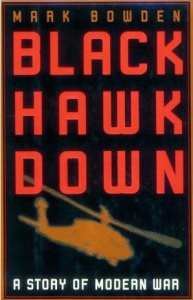
That’s not to say that it’s universally accepted. In 2008, Central Lafourche High School, home of the Fighting Trojans and my alma mater, banned the book Black Hawk Down because the language did not meet standards of decency set by the local school district. Too much cursing under fire, apparently. I suppose decent soldiers stomp their feet and say something like, “Well, drat gosh darn!” while under deadly enemy attack.

This bout of censorship could have been avoided if I owned the F word. I’d have allowed Mark Bowden, the author, to drop all the F-bombs necessary to reflect that war-is-hell-thing, since “Drat gosh darn!” just doesn’t quite cut it in my mind. And I would not have charged him a dime. In a graphic book about warfare, getting graphic is the whole point, if you ask me, and anyone who is most upset by the cursing is really, really missing that whole point.

But if I owned the F word, my control would go beyond books. Musicians, politicians, butchers, bakers, t-shirt makers, everyone would go through me before they could FU, F’ing A, M-F, F a Duck, Give a Flying F, or Go F themselves.

Such would be my power over the trademarked F word. I’d own the F’ing Nation. Maybe, with this word, the whole F’ing World.

The funny thing is, the F word has become so ubiquitous, it is more aggravating than shocking. It’s use used to mean something: rebellion, outrage, insult, titillation. Now, not so much. It’s so commonplace, it’s effectiveness has entered the land of meh. White noise. Filler. When I watched The Sopranos, for instance, the characters said it so often, I quit hearing it after a while. At times, it was so overused, I had to hear around it to catch the meaningful words.

The more I think about it, maybe someone should trademark the F word, for its own protection. Its presence impedes the conveyance of meaningful language; its overuse kills the shock value. If it was mine, I could lock it in a vault and crack it open for special occasions, such as talking dirty or showing outrage, or allow it to be used effectively and appropriately, such as when writing about war.

Or I could just recognize that trying to own a word is the same as trying to control language and free speech, and I’d leave the F word, and Hun (sic), and well enough, alone.

What do you think? Can language be owned? Am I onto riches with this plan, or should I F off with such a dumb notion?

Tell me about it.

Ramona

Guest blogging at the Working Stiffs

Today I am guest blogging with my friends, the Working Stiffs.

Topic for the day involves grudges, hatchets, revenge, forgiveness, old boyfriends and a few First State peculiarities.

Come on down!


The Agony and the Ecstacy of an Anthology

Last week, the Sisters in Crime Great Unpublished (Guppies) Chapter hit the airwaves with an exciting announcement: Fish Tales, a collection of stories by 22 Guppy authors,  was accepted for publication by Wildside Press. The aftermath of this announcement was a cyber let-the-wild-rumpus begin.  The 22 authors were happy. The Guppy Chapter was happy. SinC National was happy.

I was happy, too. I had the honor of editing the twenty-two stories that will appear as Fish Tales and working with the authors. Some of them were seasoned writers and well published. Others were newbies who submitted a first-time-out story. The stories that came to me reflected the mix of experience. It was my job to help the writers, whatever their level of experience, create the strongest story possible.

The stories were great. I had a blast.

For Fish Tales, a theme was provided: each tale had to include fish or water. The twenty-two interpretations of that make for a couple of surprises in the collection. That’s one of the joys of working with creative, inventive type folks. When faced with a seemingly innocuous theme like fish, or water, creative and inventive people come up with some really creative and inventive stuff. But that’s all I can say about that. To understand what I mean, you’ll have to buy the book.

Themed anthologies are, in my opinion, overlooked gems. They are certainly out there; some are collections put out by professional organizations like Sisters in Crime. Some are by individual writers. Here’s a sampling:

Sherman Alexie‘s Ten Little Indians shares experiences and trials of Native Americans.

In Cold Feet, Elise Juska and four other writers explore the tenuous, and sometimes terrifying, time between engagement and marriage.

Ellen Gilchrist presents a character’s life through stories in Nora Jane.

Insanity and obsession populate The Breaking P0int by Daphne DuMaurier.

It will be another year or so before Fish Tales will be a book in hand. It took twice that long, at least, to put it together from start to finish. That’s not unusual, but there is one element in the history of this anthology that is unusual.

The Guppies refer to their chapter as “The Pond.” When plans for the anthology were announced, it was decided that it would be a total Pond effort. Each author who submitted a story agreed, in turn, to read and critique other submitted stories. Each story was scored. The stories that scored the highest by the submitting authors were granted inclusion into the anthology.

In short, I edited the stories but I did not select them. The Guppies did that part themselves. Hence, The Pond as a whole shares in this joyful development through their democratic process of story selection. It’s not how every anthology is put together, but it certainly makes this one, in my mind, all the more special.

Do you have a favorite story collection? Or have written one?

Tell me about it.

Ramona


I

A Good Narrator is Hard to Find*

“An honest man is always a child.”

This quote is attributed to the Greek philosopher Socrates, who also is credited with saying, “I know that I know nothing.” We are going to conveniently ignore that second quote because a) to put it in the vernacular: He’s Socrates; if he knows nothing, dude, where does that leave the rest of us?;  and b) the first quote fits the topic of my last post: Why do readers trust a child narrator?

There’s another saying which can’t be attributed to anyone in particular, and that is that children are honest. Children tell the truth. Children don’t lie. Okay, that’s three sayings, but they claim the same thing and, pardon my French, all three are horse merde.


Children lie all the time, and they are not even good at it. A child will swear he did not give the dog his vegetables–while Rover is rolling a Brussels sprout across the floor. A child will open his eyes wide and promise he did not steal his sister’s Easter candy, while his mouth is smeared with the mangled remains of Little Sister’s chocolate bunny.

Children lie—except when they are the narrators of a book.

Last post, I shared a short list of books narrated by young characters. Most of them were Southern, reflecting my personal reading tastes. As you can see from the comments, non-Southern child narrators are popular, too. I’ve been Google-searching “child narrators” and reading about their appeal. The consensus is this: stories narrated by children are popular because readers relate to them, since everyone has been a child; and readers trust a child narrator, for the same reason. It’s a given that while real-life children will lie in their teeth about certain things, they are pure and innocent when telling stories.

Let’s work with that. What makes a good narrator? What qualities should a writer inject into the character given the task of telling the story?

This is a big topic, so I’m going to strip it down to some basics. I’ll even use an acronym. What does a writer need to GIVE a narrator to make him/her work?

GUIDANCE – The narrator is the guide of the story. He takes the reader by the hand, pulls them in, strings them along, pushes them forward, dangles them over the cliff, denouements them at the end. An author decides what kind of guide the narrator will be: Is this a solo gig? Or will there be several different narrator making a team effort? If so, how do they work with one another? Is this guide going to be straightforward and unbiased—the man behind the curtain who directs the action but never addresses the reader? Or, is this a personal journey that will allow the guide to address the reader more intimately? Is the guide going to jump around in time and space, starting with “I’m in this place and what follows is how I got here” as the impetus to share the story that is, in fact, already over? Deciding how the story will be told in terms of structure, who will tell it and in which point of view are primary decisions for GUIDANCE.

INTEGRITY – Narrators don’t have to tell the truth. They can tell the truth as they see it, as an unbiased witness to the events of the story. They can tell the truth as they perceive it, which means interpreting events to support a personal truth. They can also lie, to support their own personal agendas. Just because the narrator is telling the story doesn’t mean they are telling the true or whole story. It’s up to the reader to comprehend what the narrator is really saying. This is the fun of reading. All those words on the page—they say one thing, but they may mean another, or more, or less. So what does this have to do with INTEGRITY? Simply put, a narrator can purposefully lie to or deceive the reader, but they will not purposefully lie to or deceive themselves. Narrators can be deluded, or unreliable, or mistaken, but they don’t mislead themselves. Hence, a narrator is always true to the truth as they know it. For example, when Scout Finch tells us that Dill arrives in Maycomb in a blaze of glory, she’s telling the truth as she sees it. The reader perceives that Dill gets shuffled around from relative to relative, but Scout relays his train rides as a glamorous experience. Does this erode her integrity as a narrator? No. She is telling what she knows to be the truth. It’s up to the reader to see beyond her years and understand more.

VOICE – Narrative voice is more than language and sound and semantics; it is how the narrator delivers the story to the reader’s ear. It is the most esoteric part of GIVE, and so the most complicated. Not only does the narrator say what they say, how they say it says a great deal about them. A person from the South speaks differently than a person from the Midwest. A middle-age man who graduated from Princeton won’t speak the same narrative language as an elderly, unemployed woman who grew up on a chicken farm in Waco, Texas, or a young drug-addled runaway from Seattle. A narrator’s voice reflects both their past and current life situations. But that is only one aspect of VOICE. Another is tone. Is the narrator looking at the story through the lens of humor, even when the events are not necessarily funny? Is the narrator long-winded? Does s/he like to employ meandering sentences and long descriptions of scenery, or does s/he keep things spare? These are authorial decisions that are sometimes made before there is even a story. How many times do you read that an author heard the VOICE before they heard the story?  If this happens to you, consider yourself lucky–and listen to the voice.

EMPATHY – Not long ago, I read a novel narrated by a guy I hated. He whined. He lied. He was disgustingly narcissistic. He made excuses for destroying the lives around him. He was despicable in every sense of the word—and he was not even the criminal in the story!  He was also completely fascinating and, though I was appalled by it, he made me understand why he felt as he did. It didn’t make me hate him any less, but it did make me admire the writer for achieving that. EMPATHY means that the narrator makes a connection with the reader. It doesn’t mean the reader approves of or understands the narrator; it means the reader is engaged by the narrator’s story. Isn’t that the ultimate goal of a story? To connect with a reader? Creating EMPATHY is achieved by writing a narrator who is complete and full as a character, first, and then who performs his/her job of storytelling, second.

GIVE: GUIDANCE, INTEGRITY, VOICE, EMPATHY. These are the qualities I consider when I choose a narrator.

What are yours? What do you give your narrators? Tell me about it.

Ramona

*Not really, but I thought it was catchy, so thanks to Flannery O’Connor. Talk about a great narrator. *shivers*

Guest Blogging Today

Today, I am the guest blogger for Sisters in Crime, National Chapter.