Get Out of the Kitchen!

It’s ironic to write this a week before Thanksgiving. It’s more ironic that I—who had my first cup of café au lait before the age of five—should create a post advising writers to grab their characters and drag them away from the coffee pot.

In real life, many things happen in the kitchen. It’s the hub of activity. It’s where our bodies go for sustenance and where families bond while breaking bread. How many days do you not enter your home kitchen?  Probably none.

Writers are advised to create stories that reflect and explore real life.  This is good advice–but it does not mean your characters need to hang around the kitchen, even though in real life, real people do.

Let me put this another way. I read a lot of published books. I also read a lot of unpublished manuscripts. Guess which ones have FEWER scenes in the kitchen.

When you’re planning a story, you select interesting places for the big scenes: the opening, the point of no return, the climactic battle. Those locations are certainly important, and they certainly need to be intriguing–but those scenes don’t fill the bulk of your manuscript. You’ll devote more pages to lesser dramatic scenes and lesser dramatic locations.

Where do you send your characters for these important, but not as drama-filled, scenes?

Please don’t say the kitchen.

The kitchen is the fallback location, the comfort zone for comfort writing. After a while, comfort food gets boring and makes us fat. The same thing applies to writing scene after scene in your character’s kitchen.  One of my favorite sayings about writing is that characters sleep and go to the bathroom, but I don’t want to have to read about it. I’d like to add this to that axiom: I love coffee, but I want to drink it, not read about it.

If you leave the kitchen, where do you go? No place exotic, necessarily. Think about the places we go in everyday life:

Home….Job….Restaurants….School….Gym….Parents’ home…Friends’ homes….Grocery story….Doctor’s office….The mall….Swimming pool…..Back yard….Neighborhood….City park….The beach….Bars….Cinema….Casino….Sporting events….Dance recitals….Police station…Hospital

Next, think about the particular setting of your story: Are you writing about a real town/area? Are there historical or significant sites there? Are you creating a fictional town for your story? If so, what’s it like? Where do inhabitants go?

If you are using a real setting, consider the available historical and significant locales. For instance, if your story is set in Johnstown, Pennsylvania, how long can you go without mentioning the flood or the flood sites? Not long. They are in the residents’ faces every day, and you’d be cheating the reader by omitting them. It would be like writing a Pittsburgh story and never mentioning a bridge!

Second, think about your character’s life and world. Where, specifically, does your protagonist go every day, and why? Are those places dull? Are her days repetitive? What can you do to change them up? What can these places show about your character?

If your character likes to read, she goes to a library—or a bookstore—or a used bookstore—or a friend’s house to borrow a book—or a monthly book group. This may show her economic status and/or her social habits.

If a character has a back problem, he goes to a doctor—or a chiropractor—or an acupuncturist—or a faith healer—or a massage therapist—or ignore it until he has to go to the Emergency Room—or buy muscle relaxants from a high school kid on the street corner. These place choices can show if the character is a traditional thinker or a non-traditionalist.

Where you send your characters says something around them, so use those surroundings or locations to perform double—or triple—duty: Advance the action. Teach something new. Show something about the character.

Let’s try an exercise. Choose a generic setting location, like an apartment building. What spaces are available in this apartment building for a lesser dramatic scene?

Apartment: Hallway. Elevator. Foyer. Neighbor’s apartments. Manager’s office. Laundry room. Garden. Bench in front of apartment. Front door. Mailbox area. Roof. Balcony. Fire escape. Enclosed yard. Play area. Pool. Exercise room.

What about a farmhouse in the country?  House. Front porch. Back porch. Driveway. Barn. Garage. Garden. Fields. Swing area. Flower beds. Tool shed. Deck. Yard. On a ladder fixing the roof. On the lawnmower mowing the lawn.

See? No kitchen.

What about work? Let’s say your character is a drone who works in a cubicle making unwanted telemarketing calls to people all day. Dullest of the dull, right?  

Not if you get them out of the cubicle. Try it. Make a list of all the places your drone can go, just within the office building.

Then take your drone out for lunch, and think of all the places available for a meal. Then end the work day, and think of the various means of transportation to leave an office. Then think of all the places your drone can go to after work, rather than going directly home.

Then, when your drone is exhausted because she’s been to the board room at work, a cute little deli/bodega for lunch, a hop in a taxi, a Zumba class, a hitched ride with a friend because her car’s in the shop–let her arrive home. Where she’ll have to check her mail, cross the foyer, ride the elevator, walk down the hall, pass her neighbors’ apartments, and get to her door—all before she ever reaches the kitchen.

She’ll probably need a cup of coffee, in the kitchen, but she’s earned it. Look at everywhere she’s been today!

Sometimes You Seek the Story….

…and sometimes, through no effort of your own, it seeks you.

Last Friday, for my monthly guest gig at Working Stiffs, I wrote about the guy I knew from high school who is currently incarcerated for murder. The post earned some good responses, but I was surprised at the number of people who contacted me privately about murderers they know. I was equally surprised when someone suggested I write a book about the ten years it took for Connie’s disappearance and murder to be solved. I don’t write true crime, so that nixed that idea. Also, while I knew both the killer and the victim, I was long gone when they were married and their troubles began. My connection to them was from happier times.

This is not the first time someone suggested I turn a blog post into a book. It happened when I wrote about Dr. Earl Bradley, the Delaware pediatrician who has been called the worst pedophile in American history. His is a tale of violence, sickness and evil that might serve as a cautionary tale about people trusting figures of authority too well. But I have no connection to that case, other than living in Delaware when his arrest and trial went down. In writing the blog post, I read enough gruesome details to know I don’t want to spend a year of my life delving into the dark side of a very dark story.

My same feeling applies to the story of Patrolman Chad Spicer, who was killed in the line of duty one night two years ago. Officer Spicer was a small town Delaware boy serving on a small town Delaware police force. He had a small child, a loving family, a wonderful reputation. Is this a story someone should share? Perhaps. Is that someone me? No.

How does a writer know when a story is theirs to tell?

As evidenced above, I find a lot of blog posts to share from the news or personal experience. In my fiction writing, I steal from my family. I’ve done well by that. I’ve been awarded a couple of arts grants to record portions of my family history in south Louisiana. I feel connected, so I’ve devoted time and work to creating a fictional version of my own aunts, uncles, and grandparents. Their experiences are based on true events, though told as fiction rather than memoir. I researched to make the town and time accurate to the times. I had to do world building, but the world is based on my own genetic and cultural one. I didn’t experience or witness the events, but I molded them into my version. My story.

When you are a writer, people suggest stories to you all the time. Most of us have no problem coming up with ideas of our own, but you never know when a spark will happen. It happened to me not long ago, on my daily walk through the neighborhood. I walked by the home of someone on my street, and I thought about the rather tragic events going on with them now. And bam! I wanted to write their story, but told in my way, through a rather tragic event of my own. By the time I got home three miles later, I had a full outline brewing in my head.

The story sought me like a heat-seeking missile. I have no personal connection to it other than witnessing what went on with a family on my street, but in an hour I had made it mine. It has spoken to me.

That’s the key, isn’t it? Some stories speak to you. Some don’t. Consider that you have to spend a year of your life, at least, to devote to a novel, you want a story that reaches out and grabs you like a beast from hell and won’t let go.

Seek and ye shall find, the saying goes. Sometimes, for a writer, it’s the opposite. There are a lot of stories out there. Some of them are yours. Why write one that isn’t?

Ramona

The Basics, in 3’s

In a few weeks I will be teaching a workshop on the basics of creative writing to a group of young people. The workshop is expected to cover story, structure, character, plot and theme–you know, the basics of creative writing.

I will have one hour.

Cramming years of acquired knowledge and experience into a mere 60 minutes is a daunting task, but I did pick up a thing or two in my years of volunteering in schools and hanging around children.

When trying to teach a broad topic, use a number.

People like–and remember–numbers. This is why you see so many articles titled “Six Ways to Make Your Garden Grow,” or “Four Secrets to Conquering Belly Fat.” Notice how those are nice low numbers. If I have to do more than six things to make my garden grow, I’m throwing in the trowel. And four secrets? How many people can keep even one secret? Four is plenty. A person has to be motivated to keep four secrets.

So, not only do I need a number, I need a low number. Luckily, the basics of creative writing has a built-in appropriate number: the number three.

Why three? Why is three so special to creative writing?

Think about it.

How many basic story types are there?  Three: Man versus Himself. Man versus. Man. Man versus Nature. These break down into smaller parts, but every story can fit into one of these broad categories.

How many story lengths are there? Three: Novel, Novella, Short Story.

How many short story types are there? Three: Short, Flash, Micro.

How many acts in the Three Act Structure? Act One is the beginning, when the author needs to set up the story and hook the reader; Act Two is the middle, when the author has to dig in to make the story complex, logical and suspenseful enough to hold the reader’s interest; Act Three is the end, when the author provides a climax and resolution so the reader feels satisfied and entertained.

How many Point of View options are there for a writer to tell a story? Three. First Person, where “I” tells the story; Second Person, where “you” tells the story; and Third Person, where “He/She/It” tells the story.

How many dimensions in a well-drawn character? Three: Physical, which tells us about his outside appearance; Sociological, which tells us about his background and current life situation; Psychological, which tells us what’s happening inside his head and heart.

How many parts of a story? Three: Conflict, Crisis, Resolution.

Looking at stories in terms of three wrangles it into manageable pieces. Basics. If a young writer walks out of my workshop holding up three fingers and muttering, “Conflict, Crisis, Resolution,” I’ll be thrilled.

I only wish I had three hours.

Did I forget anything? If you were taking a course in the basics of creative writing, what three things would you like to know?

Tell me about it.

Ramona


Officer Heck? Yeah!

Over the weekend, I had a fun little discussion with my pals at How Many Pages Did You Write Today? about character names. We tossed out ways to find good names (baby name books, spam files, newspaper stories) and how a character’s name may reveal something about the person. In the course of the discussion, I mentioned my character name pet peeve.

My character name pet peeve is the cop named Mike.

Mike must be the go-to name when inventing a police character because I run across fictional Officer Mikes all the time. It’s not a bad thing, necessarily. Following the idea that a name tells about the character, the abundance of Officer Mikes make sense, in that the patron saint of police officers is Saint Michael the Archangel.

St. Michael the Archangel is usually depicted with wings, a sword, and holding scales of justice. If you are raised as a Roman Catholic, you are taught this is because Michael is the sworn enemy of Satan and the leader of the Army of God. He is one of the angels present at the hour of death to protect the souls of the dying. On Judgment Day, Michael weighs a person’s record of good deeds. He is a guardian and protector of the Catholic Church.

Add all of that up–sword, scales, guardian, protector–and no wonder a child named Michael might grow up to be a cop. It may be a chicken and egg kind of thing–the classic self-fulfilling prophecy–and this is why I see so many manuscripts with Mikes running around protecting and serving.

But maybe it’s time to give Officer Mike a rest. I’d like to propose a new go-to name for cops.

Heck.

Heck? Officer Heck? Are you laughing? Rolling your eyes?

Think about Sheriff Heck Tate, as portrayed by the character actor Frank Overton in the 1962 film, To Kill A Mockingbird.

In Harper Lee’s novel, Heck Tate doesn’t get a lot of page time. When he does appear, his actions are pivotal. It is Heck Tate who brings Tom Robinson to the next county to await trial, which shows how well the small town sheriff understands the mood and prejudices of the citizens in his jurisdiction.

It is Heck Tate who arrives with Atticus Finch when a mad dog is in the street. In this scene, Heck Tate acknowledges who is the better shot and asks Atticus to take down the dog. He puts aside whatever macho pride or male ego he may possess when he hands over that shotgun. He even teases Jem that didn’t he know his father was the best shot in Maycomb County–an important moment that lets the son see his father as an autonomous man, not just as a parent, for the first time.

It is Heck Tate who ultimately exercises what modern law enforcement calls officer discretion. Sheriff Tate has lived in Maycomb all of his life. He knows everyone in town. He obviously knows how to read a crime scene, even when his witnesses are an unconscious boy with a broken arm; a grown man hidden away for so long, he’s become mute; a scared little girl in a ham costume; and a dead man on the ground.

It is Heck Tate who knows what limelight would do to a shy fella like Boo Radley, and so it is Sheriff Heck Tate who fulfills his duty to protect Maycomb’s mockingbird.

“I may not be much, Mr. Finch, but I’m still sheriff of Maycomb County and Bob Ewell fell on his knife.”

Let the dead bury the dead, is Heck Tate’s advice. Wise words, right? I wonder if this level of officer discretion would be possible today, or if Heck Tate would be the subject of an Internal Affairs investigation by the time the credits rolled?

But I digress.

If St. Michael the Archangel made Mike a good name for cops, Heck is no slouch in the meaning department. I will be a little presumptive here and assume Harper Lee meant Heck as a shortened form of Hector.

The name Hector is Greek. It means “holding fast.” In mythology, Hector was a fearless warrior prince, the older brother of Paris. Hector’s death during the Battle of Troy was a terrible blow to the Trojans, not only because he was a brave and fierce fighter, but because Hector was wholly honorable. After Hector was killed, Achilles, who killed him, dragged Hector’s body behind his chariot for twelve days in an attempt to shame and humiliate the noble Trojan prince, but even the gods admired Hector. They took pity on him in death and protected his body from abuse.

Eventually, the Trojan War was halted for twelve days so that the people of Troy could serve Hector with proper funeral rites. He is remembered in art and literature as one of the Nine Worthies.

Today, when a police officer dies in the line of duty, legions of his fellow officers participate in public, traditional funerals meant to honor the fallen officer for making the ultimate sacrifice. I don’t know that this tradition goes back to the mythology of Hector, but it seems right.

So, Officer Heck. A fierce fighter whose name means “holding fast.” A person infused with honor. Someone prepared to make the ultimate sacrifice. I would feel safe with such a man protecting my town. 

You?

Needless to Say, or Write

If something is needless to say, why do we say it?

“Needless to say” acts as a disclaimer. It means that whatever the speaker (or writer) plans to say next, doesn’t need to be said. The speaker understands and acknowledges this through the use of the disclaimer–but says it anyway. Why we persist in saying something that doesn’t need to be said doesn’t make much sense, but the phrase is a common one.  Proof? I just used it in the title. Needless to say, I thought it was catchy.

A disclaimer phrase acts as a lead-in–or, perhaps, a warning. Consider the phrase “No offense, but….” Anyone who has ever said, or heard, or been in the vicinity of anyone who has ever said or heard, “No offense, but…” knows what’s coming next. Something offensive.

“No offense, but…” is a lead-in that gives the soon-to-be-offended party time to prepare.  Unfortunately, it’s probably not enough time to run away and not have to hear whatever ignorant, unflattering or insulting comment the speaker feels compelled to make, which just by saying “No offense, but…” shows the speaker knows s/he should not be saying it. “No offense, but…” is a somewhat more polite way of saying, “Brace yourself, I’m about to insult you.”

As I edit manuscripts, I find quite a few disclaimers and lead-ins. I also find words that are needless to write. Sometimes it’s repetition or redundancy.

Example: “She gave a final, last push against the door.”

Final and last? This reminds me of when I tried to train my dog to sit. I was an inexperienced dog owner. I didn’t know about first you say, then you show. I would give the command–“Sit!”–and my dog would continue to stand. Usually,  she’d wag her tail, to show she was happy I was talking to her. Instead of reaching out and pushing her bottom to the pavement to demonstrate “Sit!” I would repeat the command. Over and over. I’m sure, at least once, I said, “This is the final,  last time I tell you to sit!”

My dog never learned to sit properly.

Here’s another example: “He popped off a quick fast jab.”

This may be for style or effect, but it’s still overkill.  The use of words that mean the same thing, twice, don’t add information. They just add to the word count.  As a reader, I am reading more words, without learning any more information.

This one reminds me of word problems in math: “John was taking the train to Baltimore, so if the train traveled at the normal speed for 10 miles and a quick fast speed for 15 miles, what time would John arrive at the aquarium?”

I was never any good at word problems.  

Oftentimes, needlessly offensive words hang around our body parts.  

Example: “I nodded my head.”

Your head? Really? As opposed to nodding your foot?  Your elbow? Your spleen?

Example: “I shrugged my shoulders.”

Shoulders are the #1 recipient of shrugs. #2 would be…there is no #2 in shrugging. You shrug your shoulders because no other body part can be shrugged.  You can “shrug it off” but the “it” is relative, and no matter what “it” is, if you shrug it, your shoulders are involved. You can shrug off your jacket, but again, there are the shoulders. Face it. Shrugging = shoulders. Which means, you don’t have to write it down. It’s understood.

Example: “I waved my hand goodbye.”

“Wave” is a fine example of a verb that can be applied to a plethora of choices. You can wave a flag. You can wave a handkerchief. You can wave your hair. Wave is a busy little verb. But if you write, “I waved my hand goodbye,” you’re wasting words. “I waved goodbye” is good enough. We know your hand was involved.

It’s akin to writing, “My legs ran across the road.” Think how busy your legs would be if you included them in every sentence. “I bent my legs at the knees and sat.” “I propelled my legs forward in a speedy motion and ran.” “I used my legs muscles to raise myself and stood up.” Do we write this way? No. We write, “I sat.” “I ran.” “I stood up.” 

This reminds me of one of my favorite sayings about writing: Characters sleep and go to the bathroom, but that doesn’t mean I want to read about it.

And no offense, but…if you are including all that stuff about the legs, you need to work on your writing. 

Does this apply to every body part and verb? No. “Cross” can apply to a range of body parts. You can cross your arms, your legs, your eyes, your ankles. (You can also cross your enemy to show danger, cross off a tip, or cross yourself to show faith, but that’s another blog.) So if you write “I crossed” you need to add a body part.

Ditto on licked: “I looked into his handsome face and licked my lips.”

Now leave out the body part. “I looked into his handsome face and licked.”

That might be fun, but it sure changes the meaning, doesn’t it?

Language can be general, or it can be specific. Meaning can be interpreted. Word count, however, is a number. If you don’t need extra words, don’t add them. If you do, you’ll make the reader work unnecessarily hard, and that might make them late to catch the train to the aquarium.

And needless to say, this is the final last time I will write about it.

Is Your Story on Cruise Control?

On the day I packed my first car with stuff for my first apartment, my dad gave me some useful advice. “Don’t lock your keys in the car.”

Does anyone actually need to be told that?

Apparently I did, because after I put the keys in the ignition, I decided I should “freshen up” one last time. (A leftover from summer car vacations and Daddy’s pre-boarding announcement: “Do your business now because I’m not stopping until we hit Mobile!”) I got out, closed the door—which was locked. One set of keys back then, too, so we had to call the dealer to cut a new set.

After that day, every time I left home, Daddy’s parting words were, “Don’t lock your keys in the car.” This spring, I noted in “I’m A Big Girl Now” how I finally redeemed myself, but I never locked my keys up again. I learned my lesson.

I’m not a car person. Like a lot of writers, I do like long drives that allow me to think about a story problem, but vehicle prestige means nothing to me. I care about gas mileage and dependability.  My husband bought a new car a few weeks ago. I’ve never driven it. It’s blue. That’s all I know.

Oops, I lie. I also know there’s no cruise control, because he complains about it.  I never use cruise control. It makes me feel out of control. I may not care about a car’s make or model, but I do want to feel in control when I’m driving it.

In writing, control is important. Every story, every tale, is about control. Think about it. Control. Who has it, who wants it, who needs it, who steals it, who denies it. What is being controlled. Why is it being controlled. What happens if the wrong person gets control. What happens when the person or entity in control gets out of control. What happens to the person who loses control.

To continue the car theme, a writer is the driver of the story. It’s the writer’s job to set the pace, move it along, and navigate the trip. It’s a big challenge, and unlike real drivers, there are no set rules and laws about a writer’s journey.  No cruise control that allows the story to write itself.

Ergo, it’s easy to lose control. How? Here are a few ways:

DROWNING: What happens if your car won’t start and you give it more and more gas as you wait for that magical sound of the engine turning over? You drown the engine and make it worse.

In writing, drowning is overloading the reader with wave after wave of information that is not action. It can be the dreaded back story info dump. It can be a long, misplaced description. It can be the history of a place, or a person, or a relationship. Whatever it is in particular, if it stops the story so that the reader has to stop to digest it. It halts momentum and destroys suspense. It kills the engine. You can’t control a dead engine. You, as a writer, will have to work much harder to bring the story back to life—if the reader hasn’t walked away to find a more dependable vehicle.

MEANDERING: Who doesn’t like a Sunday afternoon drive through picturesque scenery? What writer hasn’t written a character who pops up and does something unexpected?  A “Where did that come from?” moment can be intriguing, and it might lead your story down an unexpected path—or it might derail the whole thing. When a plot starts to go off on tangents or spends too much time on a secondary storyline, or the author intrudes to babble about a political message, social commentary or pet peeve, the reader is taken out of the real story.

If a great new unplanned idea pours out through your fingers, take a moment to consider where this is going. How will going there affect the primary plot line? Joy rides may be fun, but they can also end in disaster.  Not everyone outlines or uses note cards when creating their stories. I’m not going to try to pen in a person’s creative process. But maps can be your friend and get you to the end of the story journey in the most sensible and economical way possible. It can be a written map or a mental one, as long as you know the final destination, and how to take a reader there without needless wanderings.

STALLING – Stalling is not the same as drowning. Stalling is what a writer does when a difficult scene is ahead, and the writer doesn’t want to write it. It may be an action scene, which many writers find hard to control because of numerous characters or complex staging. Characters must be unnaturally aggressive, or there may be violence or danger. It may be a highly emotional scene, with intense internal conflict that’s tough for the author to address.

How do writers stall? They give their characters mindless tasks to do before they head out to the climactic scene. They write long dialogue exchanges that reek of avoidance. They over describe every move the character makes, or over explain why the character makes every move he makes.

If a tough scene is ahead, and you find yourself writing and writing but never getting there, take a look at what you’re writing. Is it moving you closer to the conflict, or stalling you in one spot to dither? Don’t dither. Shift. Press the accelerator. Move forward.

SPEEDING – You’re almost at the end. It’s so close, it’s palpable. You feel that “almost there” rush.  And thank goodness, because you’ve been working on this for a year and it’s time to finish and be done! So you type like a fiend, and then voila! C’est tout! And so what if maybe you didn’t explain very thoroughly or show the character’s emotional responses or tie up every loose end. Readers like to reach the end without a lot of malarkey dropped around. They aren’t dumb. They don’t need every little thing explained to them, do they?

Readers don’t want to feel rushed, so an adrenaline kick for a writer may translate into a rush job for a reader. Readers aren’t dumb, and they don’t need to have story points rehashed after a climactic scene, but a denouement is important. You and the reader have been together for 300-400 pages. She’s grown fond of characters, or grew to hate them. Either way, an emotional tie has been made. Speeding through the payoff is going to frustrate a caring reader, and leave them unsatisfied. Slow down, speed demon, and enjoy the last leg of the journey. Leave your audience something to think about. Everybody likes a trip souvenir.

Do you have trouble maintaining control of your story? Some hints on how to keep pace? Tell me about it!

The Pig Ate The Baby!

This past weekend, I was one of five judges for a local literary contest. We met at someone’s home and spent hours discussing the stories and how the dozens of writers had interpreted the contest’s theme. We voted and argued and hashed out our opinions until we agreed on the winning stories.

Post judging, we had dinner. And because we’d talked about stories all afternoon, we talked about stories all evening, too. And somewhere in there, we discussed stories we’d read in high school. Stories we loved. Stories we hated. Stories we loved and everybody else hated. (I’m looking at you, Silas Marner.)


My most loved book in high school was not The Grapes of Wrath, but it was the most memorable. Senior year, I took an American Literature class as an elective. This class was populated by a lot of boys, from a lot of sports teams, because one of the coaches let slip that this particular teacher in this particular elective let students read in class. And she gave open book tests. TAKE HOME open book tests. This was the only class in my high school with a waiting list. I don’t know how I got in, to tell you the truth.

Continue reading “The Pig Ate The Baby!”

Faulkner’s Human Heart

“The world’s gone mad,” was my mother’s response to the news that the heads of two mummies from the King Tut era had been torn off by protestors who broke into the famed Egyptian Museum this past weekend. This was a sad statement from a woman who was born in rural south Louisiana during the Great Depression and who, in the past  five years alone, had witnessed her home state get massacred first by a disastrous hurricane and then by a disastrous oil spill.

In times of such madness, it may seem silly to write stories. I spent part of this week going back and forth with a client, discussing theme. Specifically, how a writer makes a story bigger and more meaningful by addressing a big, meaningful theme. What sort of subjects touch and move readers? Continue reading “Faulkner’s Human Heart”

The Author Known as Anonymous

That wily writer known as Anonymous is at it again. In just a few weeks, his new book, O: A Presidential Novel, will hit bookstores. No one knows who has written this new story of O, but the guessing is becoming fierce. In fact, if the author is not unmasked by the publication date, I, personally, will lose ten bucks.

O: A Presidential Novel is a roman a clef, which means readers will have the fun of recognizing “characters” and “scenes” in the story as real people and real events. For those not familiar with literary terms, roman a clef is French for “you can’t sue the author for this unflattering portrayal because you are a public figure.”

It’s about time that Anonymous has come out with a new book. His last big seller (not counting the AA Bible, which is Anonymous’ greatest work, in my opinion, and a perennial good seller) was Primary Colors in 1996. Primary Colors is also a roman a clef and it skewers the Clinton administration in a devastating, though amusing and affectionate, fashion.

Primary Colors’ author was outed. He acknowledged his authorship soon after the book came out. I won’t reveal his name here because I want to honor the spirit of anonymity, and because everybody already knows it’s Joel Klein.

The two above novels were marketed as fiction– roman a clefs, political commentary, social criticism, too, but still fiction. Fiction with a message is still fiction.

Which brings me to one of Anonymous’ other greatest hits.

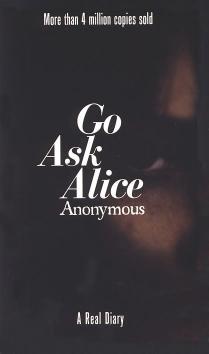
I was in the sixth grade when Go Ask Alice was published. Needless to say, I didn’t buy a copy hot off the bookstore stands, as it was not appropriate reading for a 12-year-old (then) and I was attending a Catholic school that featured a nun who confiscated my copy of Love Story because it was racy and inappropriate. Yes. Love Story.

I read Go Ask Alice a few years later, when I was at a public high school and was blessed with an English teacher who wasn’t scared of controversial books. For those unfamiliar, the book was marketed as the true diary of an anonymous teenage girl who fell into a life of drug addiction. The title is a reference to the Jefferson Airplane song “White Rabbit.” In the book, the narrator never gives her name. Her drug experiences begin at a party, when her drink is spiked with LSD.

From the reading perspective of a 14-15 year old in a small town with no personal contact with anyone who used illegal drugs (as far as I knew), my take on the story was as follows. One minute this girl is sipping a spiked drink, and the next thing you know she’s giving daily BJs to a pimp named Big Ass. (Hey, it’s in the book.) For an impressionable girl, the line “Another day, another blow job” was much more effective phrasing than Just Say No, but you can’t put that on a billboard. Although, at this point in the war on drugs, maybe we should.

My point is, for me, Go Ask Alice worked. I was sure this girl was real; I was nowhere near her world, and I was glad for that, because her world scared the living bejeezus out of me.

So imagine my sense of betrayal when I learned that it was a hoax.

The reveal came several years ago, after I overheard the following conversation in a bookstore.

Customer: I need to know the author of Go Ask Alice.

Employee: The author is Anonymous. We have a copies over here—

Customer: I have a copy. I need to know the author’s real name.

Employee: Ma’am, it’s Anonymous.

Customer: Fine. I’ll look it up on the Internet.

Silly woman, I thought, the author is Anonymous. You can’t find it on the Internet. But of course, I went home and immediately looked it up on the Internet and found out the author’s name. Go Ask Alice was not the real diary of a real girl who drank one spiked drink and fell into a life of fear, degradation, sadness, pain and abuse. It was a “based on” a real person and a “compilation” of incidents.

I was crushed. I admit it. I re-read the book and felt more crushed. As an adult, I saw the manipulation. As a writer, I recognized that the voice was not true to a teenager. As an editor, I noted the glaring bits of author intrusion.

But back when I read it, initially, all I saw was a real girl whose life scared me, made me worry and made me cry.  I believed that diary. I felt every word of it. I felt tricked. Duped. I don’t like feeling duped. Years have passed since I learned that Go Ask Alice is a work of fiction, but I still feel duped.

When writing for a young audience, authors are advised not to write down to them. Be honest and respectful of the reader while acknowledging the level of reading skill. I’ve written for children and understand this challenge, but I would also add to that writing advice to play fair with the reader. Especially a young reader.

Unlike Joel Klein and the soon-to-be-outed-author-of-O, the Anonymous who wrote Go Ask Alice was purposefully deceptive. Which burns my grits.

And yet.

I can’t say that Go Ask Alice is the sole reason that I, to this day, have never even indulged in a puff of mj, but it contributed. Would I have connected to the character as strongly if I knew she was fictional? No. My heartfelt response to her was because I believed she was real. So I wonder. For Go Ask Alice, did Anonymous’ ends justify the means?

Tell me what you think.

Ramona

The Chicken, The Egg and Wet Mr. Darcy

Not long ago, I witnessed a debate on a professional list-serve about creativity. The conversation questioned if artistic, creative people are born that way, or if art and creativity can be taught.

It was interesting to read people’s thoughts on this topic. But then it began to turn into one of those conversations that go round and round in chicken-or-the-egg fashion, like nature vs. nurture in genetics; should prisoners be punished or rehabilitated; does spanking create bullies; and is Colin Firth the one true Fitzwilliam Darcy?

After a while, I checked out of the conversation because my own opinion is, in practical terms of life and work, Who cares?

If I want to improve my skill set as an editor, writer, or any other creative endeavor, I’m going to do so by practice, education, and trial and error. That’s what works for me. In my mind, and world, it makes no difference if my working skills came as a gift I learned to use, or a skill I learned to develop. I just want them, as many as possible, and I want to use them in the best and most efficient way possible. That means learning. Sometimes that means school.

In 2009, when I received an Artist Fellowship from the Delaware Division of the Arts, I used part of the grant funds to attend a week-long short story course at Rosemont College, in Bryn Mawr, Pa. The Rosemont Writers Retreat is presented by Philadelphia Stories and taught by Elise Juska. Spending a week immersed in short stories, with a small group of writers, was right up there with a week at Pemberley, in my book.

This year, I’ve decided to start 2011 with more school, so I enrolled myself in Alexandra Sokoloff’s Screenwriting Tricks for Authors online workshop. The course began on New Year’s Day with a bang of students describing projects and working on premises. Three days in, I have a notebook going full of insightful questions about my own WIP, and a list of books and films to study as structure models. Already I feel I’ve more than earned back the (shockingly small) fee I paid, and there’s still two more weeks to go.

But I confess that while this course is great, story structure is not wholly new territory for me. If I really want to expand my skill set, I need to try a new area of creative work, and push my comfort zone as an artist. This is scary stuff. It’s putting yourself out there. Sort of like what this guy had to do.

You can’t learn if you don’t try, so I’m going to do it. After Alex’s course on story structure, I’m plunging right into…..a poetry class.

Yes. Poetry.

I am not a poet. I like poetry. I read it. I have friends who are poets. They are just like me, except they know how to write poetry. Were they born with that skill, or did they learn it?

I don’t know. I do know that I’d like to know how to write poetry, so I’m taking a course, sponsored by the Delaware Literary Connection and taught by Maryland poet Josiah Bancroft.

Will I write decent poetry? Is there a little poet person living inside of me since birth, just waiting to get out? Is there a black hole where my inner poet should reside and I’ll take this course and find that out? I don’t know the answer. But I know I’ll never know if I don’t try to find out.

Are you starting a brave new decade with trying to learn a new skill? Taking a course? Writing a poem? If so, I’d like to hear about it, so I can applaud your efforts.

I’m not sure it really matters how you learn to create, as long as you answer whatever part of yourself urges you to do it.

It’s sort of like this question: Is there such a thing as too many wet Mr. Darcys?


Tell me about it.

Ramona